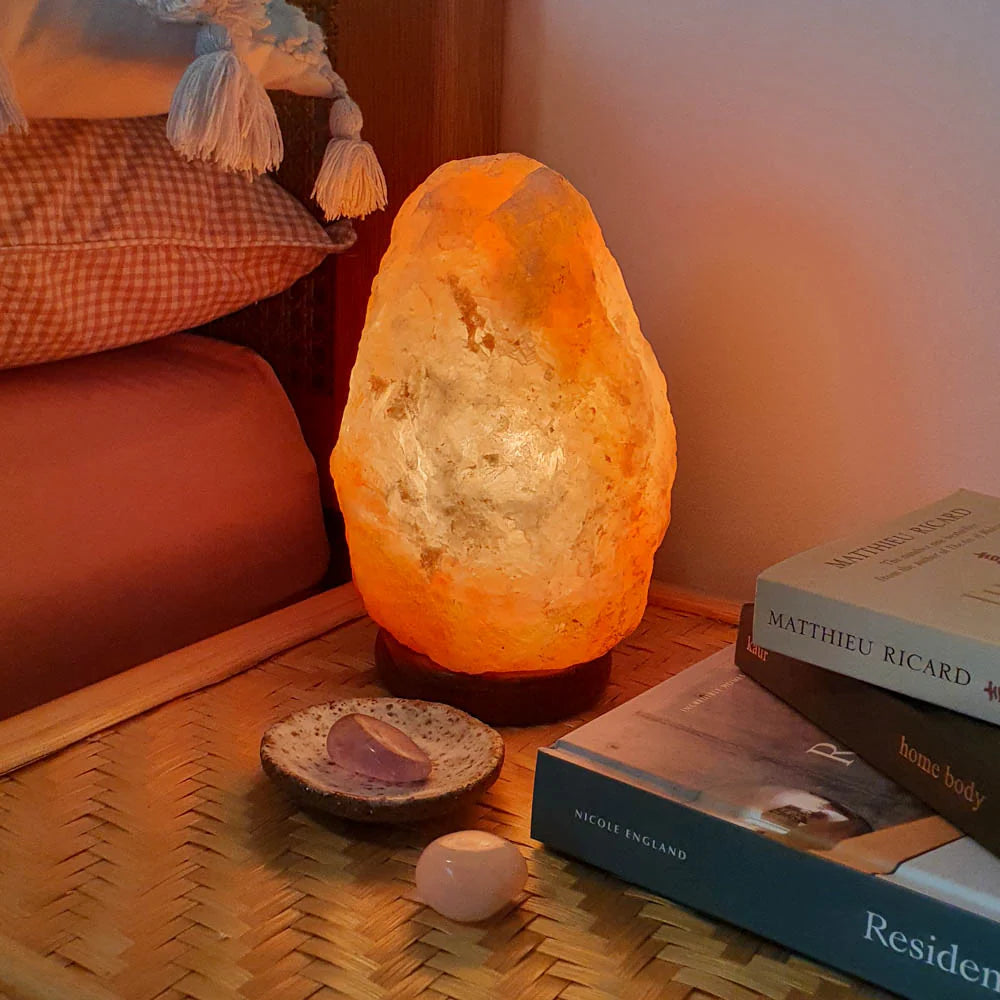


Why handmade salt lamps are prized as decor
Handmade Himalayan salt lamps are prized chiefly for their one-of-a-kind natural appearance and warm amber glow, not for scientifically verified health effects. Each lamp is hand-carved from ancient salt crystal mined in the Khewra Salt Mine, Pakistan, producing a piece that no factory process can replicate. The warm, low-lux light they cast supports evening relaxation in a way that mass-produced alternatives simply do not match aesthetically. Understanding why salt lamps handmade versions specifically command such loyalty means separating genuine decor and lighting value from the more contested wellness claims that surround them.
What makes handmade salt lamps unique compared to mass-produced versions?
Handcrafted salt lamps stand apart because no two lamps are alike in shape, colour, or surface texture. Natural variation in the crystal structure means one lamp may glow deep amber while another casts a softer peach or rose hue. That unpredictability is the point. Buyers seeking unique salt lamp features are purchasing something closer to a sculpture than a commodity product.
Craftsmanship versus cheap alternatives
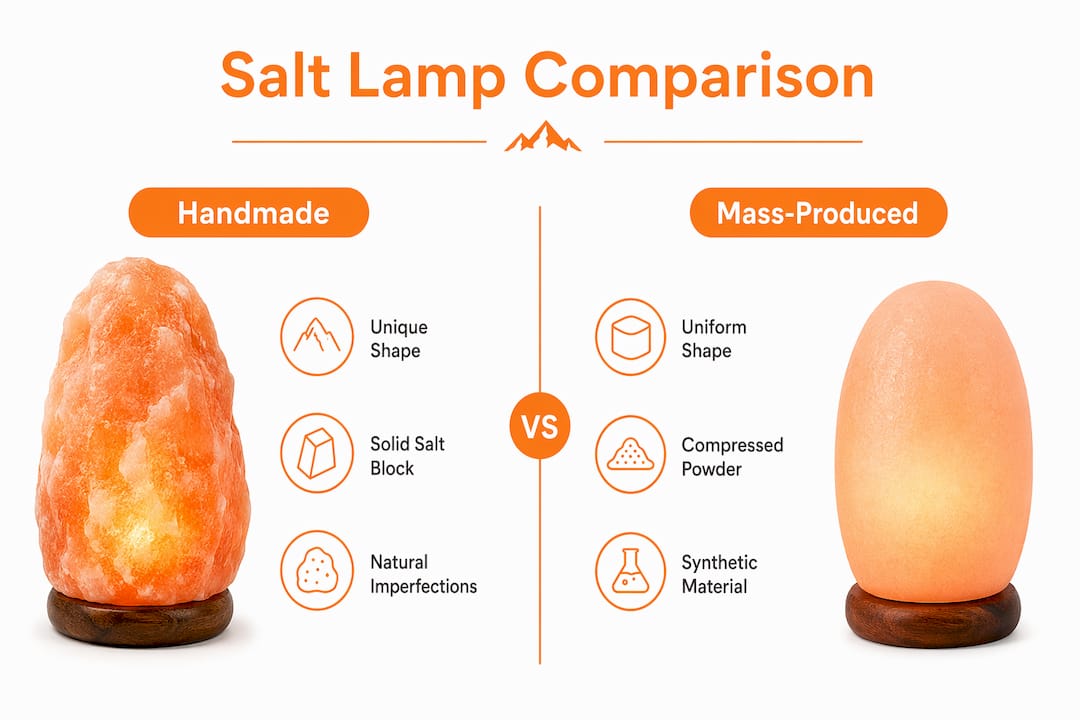
Mass-produced salt lamps are often cast from crushed salt powder compressed into moulds, or made from synthetic materials designed to mimic the look of genuine crystal. Handmade versions use solid, unprocessed salt blocks shaped by hand tools, preserving the natural contours of the original crystal. Solid wooden bases and quality cords are standard in reputable handmade lamps, adding structural stability and a premium feel that cheap imports rarely match. The difference is immediately visible: a genuine hand-carved lamp has irregular facets and depth of colour that a moulded replica cannot reproduce.
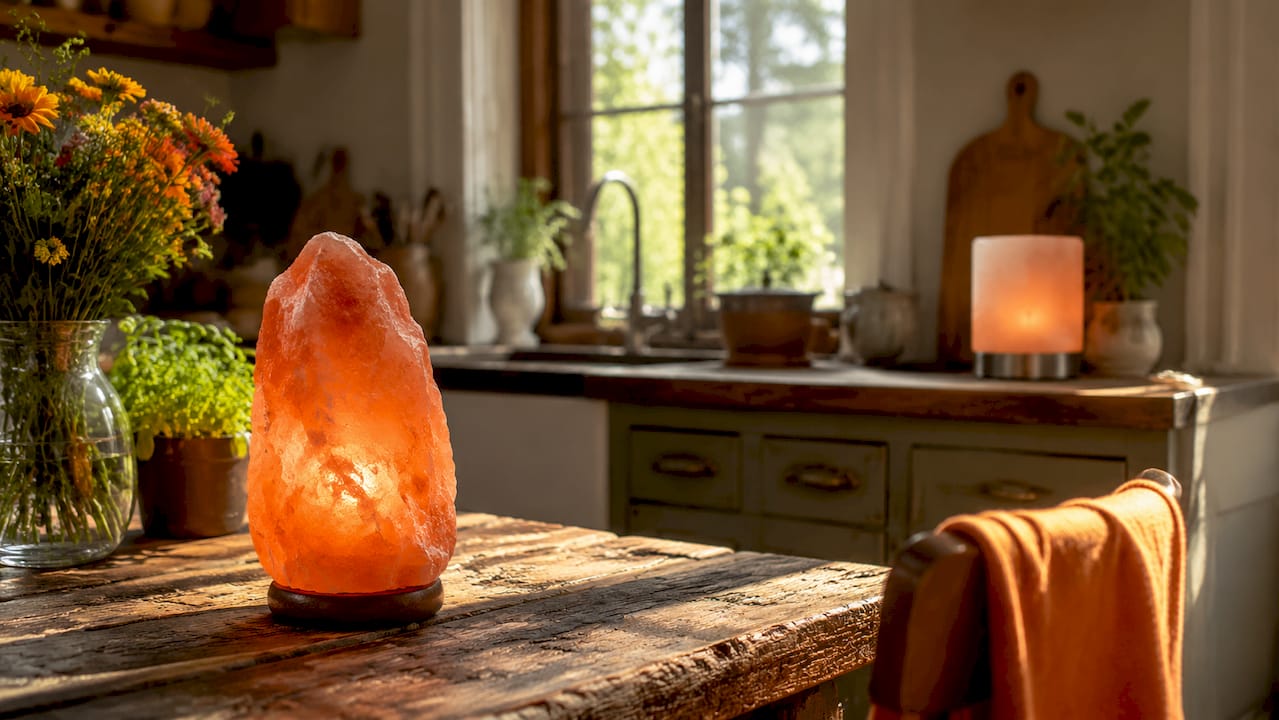
Why buyers pay more for handcrafted pieces
The advantages of handmade lamps extend beyond looks. The table below summarises the key differences between handmade and mass-manufactured options.
| Feature | Handmade salt lamp | Mass-manufactured lamp |
|---|---|---|
| Crystal origin | Solid natural salt block | Crushed powder or synthetic |
| Appearance | Unique, irregular, natural colour variation | Uniform, predictable shape |
| Base quality | Solid wood, quality cord | Plastic or low-grade wood |
| Durability | Higher, due to solid construction | Lower, prone to crumbling |
| Decor value | One-of-a-kind statement piece | Generic, interchangeable |
The core appeal is clear: a handmade lamp is a permanent, singular object with character. That is why discerning buyers consistently choose handcrafted salt lamps over cheaper alternatives when decorating a living room, bedroom, or meditation space.
Pro Tip: When buying a handmade salt lamp, look for visible chisel marks and surface irregularities. A perfectly smooth, uniform surface is a strong sign the lamp was moulded rather than hand-carved.
What does science actually say about salt lamp health claims?
Salt lamp healing properties are widely marketed, but the scientific evidence does not support most of them. Salt lamps emit negative ions at concentrations close to background atmospheric levels, far below the threshold needed to affect air quality. Measurements show fewer than 50 ions per cubic centimetre, whereas effective particle agglomeration requires roughly 10,000 ions per cubic centimetre. That gap is not a minor shortfall. It makes ion-based air purification from a salt lamp practically impossible.
The air purification myth
Salt absorbs moisture from the surrounding air, which is why lamps can feel damp to the touch in humid rooms. Some sellers claim this hygroscopic action pulls airborne pollutants into the salt surface. Room-scale studies show zero measurable reduction in particulate matter or volatile organic compounds. A salt lamp’s surface can accumulate dust locally, but it does not circulate or filter room air the way a HEPA purifier does. Effective indoor air purification requires active airflow and dense filtration media. A decorative lamp has neither.
The following points summarise what the evidence does and does not support:
- Negative ion emission: Negligible. Not sufficient for any measurable health effect.
- Air purification: No evidence of whole-room particulate or VOC reduction.
- Mood improvement: Plausible, but attributable to warm lighting rather than salt chemistry.
- Humidity control: Salt attracts moisture but does not dehumidify a room meaningfully.
- Antibacterial effects: No peer-reviewed evidence supports this claim for decorative lamps.
This does not mean salt lamps have no value. It means their genuine value lies elsewhere, specifically in the quality of light they produce.
How do salt lamps support wellbeing through lighting?
The credible wellness mechanism behind salt lamps is straightforward: warm, dim light supports relaxation and sleep preparation. Colour temperature at 1800 to 2200 Kelvin with low illuminance of 5 to 15 lux creates a melatonin-friendly pre-sleep environment. Blue-spectrum light suppresses melatonin production; amber light does not. Switching to a salt lamp in the hour before bed is a practical way to reduce blue light exposure without using screen filters or specialist bulbs.
Here is how to get the most from a salt lamp as a lighting tool:
- Place it in the bedroom. Use it as your only light source for the final 60 minutes before sleep. The low lux output is intentional, not a limitation.
- Replace overhead lights in the evening. Bright overhead lighting in the 5000 to 6500 Kelvin range actively delays sleep onset. A salt lamp at 1800 to 2200 Kelvin does the opposite.
- Pair it with a consistent routine. The psychological benefit of a repeated pre-sleep ritual, such as dimming the room and switching on the lamp, reinforces the body’s wind-down cue over time.
- Use it during meditation or reading. Low, warm light reduces visual fatigue and creates a calm atmosphere without the harshness of standard bulbs.
Any warm amber light source achieves similar sleep and relaxation benefits, since the effect derives from colour temperature and illuminance rather than salt chemistry. The difference with a handmade salt lamp is the aesthetic experience: the organic glow through natural crystal is visually distinct from a standard amber bulb. Luxury candle lighting, such as those from warm candle collections, produces a comparable colour temperature and can complement a salt lamp in a layered lighting scheme.
Pro Tip: Do not use a high-wattage bulb in your salt lamp. A 15-watt bulb is sufficient for a 2 to 3 kg lamp. Higher wattage raises surface temperature, accelerates moisture evaporation, and increases the risk of cord damage over time.
What should buyers consider before purchasing a handmade salt lamp?
Buying a handmade salt lamp well means knowing what to look for and what to avoid. Quality varies significantly across the market, and a few practical checks protect both your investment and your home.
- Verify authenticity. Purchase from retailers who specify 100% genuine Himalayan salt sourced from Pakistan. Vague descriptions like “natural salt” without origin details are a warning sign.
- Check the base and cord. A solid wooden base and a UL-listed or CE-marked cord are non-negotiable for safety. Avoid lamps with plastic bases or unmarked electrical components.
- Manage moisture carefully. Salt lamps accumulate moisture rapidly in high-humidity environments. Place them on a waterproof mat or tray, away from open windows, bathrooms, and kitchens. Never leave a lamp switched off for extended periods in a humid room, as pooled moisture can damage furniture and create electrical hazards.
- Keep away from cats. Salt licks can cause hypernatremia in cats, a condition involving dangerous sodium overload. A lamp accessible to a curious cat is a genuine health risk for the animal.
- Recall awareness. A 2017 product recall in North America covered certain salt lamp dimmer switches due to overheating risks. Always buy from retailers who can confirm their products meet current UK electrical safety standards.
- Size the lamp to the room. A 2 to 3 kg lamp suits a small bedroom. A 10 kg or larger lamp is more appropriate for a living room. Undersized lamps in large spaces produce negligible ambient effect.
For a deeper look at what distinguishes authentic pieces, the carved salt lamp guide at Thehimalayansalt covers the key quality markers in detail.
Key takeaways
Handmade salt lamps deliver real value as unique natural decor and warm amber light sources, but their air purification and ion emission claims are not supported by evidence.
| Point | Details |
|---|---|
| Uniqueness is the core appeal | No two hand-carved lamps are identical in shape, colour, or texture. |
| Ion emission is negligible | Salt lamps produce fewer than 50 ions/cm³, far below the 10,000 needed for air cleaning. |
| Warm light is the real benefit | Colour temperature of 1800 to 2200 Kelvin supports melatonin production and pre-sleep relaxation. |
| Safety checks matter | Verify CE-marked cords, use waterproof trays, and keep lamps away from cats and high humidity. |
| Handmade outperforms mass-produced | Solid crystal construction, wooden bases, and natural variation make handmade lamps more durable and visually distinctive. |
Why I think the honest case for salt lamps is stronger than the hype
I have seen the salt lamp market swing between two extremes: breathless wellness claims on one side and flat dismissal on the other. Neither is useful. The honest case for a handmade Himalayan salt lamp is actually quite strong, provided you know what you are buying it for.
The ambient light argument is real. Warm, dim light in the evening genuinely supports sleep preparation, and a hand-carved salt lamp produces that light in a form that is aesthetically far more interesting than a standard amber bulb. The full guide to Himalayan salt lamps at Thehimalayansalt covers this well. What I find frustrating is when retailers lean on ion emission and air purification claims that the evidence simply does not support. It undermines trust in a product that has genuine, defensible value.
My advice: buy a handmade salt lamp because you want a singular, natural object that casts beautiful warm light in your home. Combine it with other proven sleep hygiene practices, such as consistent sleep times and reduced screen use. Do not buy it expecting it to clean your air or cure anything. Managed expectations make for satisfied buyers, and satisfied buyers are the ones who keep their lamps for years rather than relegating them to a cupboard after six months.
— asad
Discover authentic handmade salt lamps from Thehimalayansalt
Thehimalayansalt offers a curated selection of genuine hand-carved Himalayan salt lamps, each sourced from authentic Pakistani salt crystal and finished with solid wooden bases. Every lamp is unique. No two pieces share the same shape or colour depth.

If you want a statement piece for a bedroom or living room, the large Himalayan salt lamp at 22 to 26 kg delivers a commanding amber glow that transforms any space. Prefer something more compact? The grey salt lamp at 3 to 5 kg is a refined option with a cooler, more understated tone. Free UK shipping is included on all orders. Shop the full crafted salt lamps collection and find the piece that suits your space.
FAQ
Why are handmade salt lamps more expensive than standard ones?
Handmade salt lamps are carved from solid natural salt crystal by hand, using no moulds or compressed powder. The labour, material quality, and uniqueness of each piece justify the higher price compared to mass-produced alternatives.
Do salt lamps actually purify the air?
No. Salt lamps emit negative ions at levels far too low to affect air quality, and they do not filter particulate matter or VOCs. Effective air purification requires active airflow and dense filtration media such as HEPA filters.
What is the real benefit of using a salt lamp at night?
The primary benefit is warm amber light at 1800 to 2200 Kelvin, which reduces melatonin suppression compared to standard white or blue-toned lighting. This supports a calmer pre-sleep environment and easier sleep onset.
Are salt lamps safe to leave on overnight?
Salt lamps with CE-marked cords and appropriate wattage bulbs are generally safe for extended use. However, lamps placed in humid rooms should sit on a waterproof tray, and cords should be checked regularly for moisture damage or overheating.
Can salt lamps harm pets?
Yes. Salt lamps pose a toxicity risk to cats in particular. Licking the salt surface can cause hypernatremia, a dangerous sodium overload. Keep lamps out of reach of cats and other pets that may be attracted to the surface.