Skip to content
⚡ 50% OFF Entire Store | Limited Stock
Free Shipping Within UK
Wish lists Cart
0 items
Language/Currency sidebar

Currency

Articles

What is a USB salt lamp: your complete guide

20 May 2026

You’ve probably spotted one glowing softly on a colleague’s desk or a bedside table and wondered what the fuss is about. A USB salt lamp is a compact, USB-powered version of the classic Himalayan salt lamp, and it comes with a host of bold claims attached. Air purification. Better sleep. Positive energy. But how much of that is real? This guide cuts through the noise, explains exactly what these little lamps are, what the science actually says, and how you can use one to genuinely improve your home environment.

Table of Contents

Key takeaways

Point Details
USB salt lamps defined Compact Himalayan salt lamps powered via 5V USB, typically drawing 3 to 7 watts.
Air purification is a myth Ion output is far too low to purify air; mechanical HEPA filters are far more effective.
Genuine benefit: ambient light Warm amber glow at 1800 to 2200K supports melatonin production and better sleep.
Safety matters Choose lamps with certified electrical components and place on moisture-resistant surfaces.
Best used in the evening Use your lamp as part of a wind-down routine for maximum sleep hygiene benefit.

What is a USB salt lamp: design, power, and function

A USB salt lamp is exactly what it sounds like. It is a small chunk of natural pink Himalayan salt crystal, carved or shaped into a lamp, with a USB cable attached rather than a traditional mains plug. The salt is mined from the Khewra Salt Mine in Pakistan, one of the oldest and largest salt deposits in the world. The distinctive pink and orange colouring comes from trace minerals including iron, magnesium, and calcium locked inside the crystal.

The power setup is straightforward. These lamps operate at 3 to 7 watts via a standard 5V USB connection, which means you can plug them into a laptop, a phone charger, a power bank, or a USB hub. No special adaptor needed. That low wattage is enough to warm the salt slightly and produce a soft, amber glow, but it is nowhere near the output of a full-sized mains-powered lamp.

Here is what you typically get with a USB salt lamp:

  • Size: Usually between 500g and 1.5kg, small enough to sit on a desk or shelf
  • Colour options: Natural pink, orange, or multi-colour LED variants that cycle through hues
  • Shape: Rough natural chunks, spheres, pyramids, or carved decorative forms
  • Cable length: Generally 80cm to 150cm, suited to desktop or bedside use
  • Brightness: Gentle and diffused, not bright enough to read by but ideal for ambience

Compared to a traditional plug-in salt lamp, the USB version is far more portable. You can take it to the office, a hotel room, or a student flat. The trade-off is wattage. A larger mains lamp might run at 15 to 25 watts, producing more heat and a stronger glow. The USB version is quieter, cooler, and more subtle in every sense.

Pro Tip: If you want a warmer, more intense glow from your USB lamp, look for models with a dimmer switch or a colour temperature setting. Some multi-colour variants let you lock onto the amber setting for the best sleep-supportive effect.

Infographic comparing USB and standard salt lamps

The science behind air purification claims

This is where things get interesting. The most popular claim about salt lamps is that they release negative ions, which purify the air and improve your mood and health. It sounds plausible. The reality is quite different.

Scientific testing shows that USB salt lamps emit fewer than 50 negative ions per cubic centimetre. The threshold at which negative ions actually affect air quality or human biology is above 10,000 ions per cubic centimetre. That is not a small gap. It is a difference of several hundred times. The ion output from a USB salt lamp is barely above indoor background levels, meaning the lamp adds almost nothing measurable to your air.

What about particulate matter and volatile organic compounds? Controlled tests found zero measurable reduction of PM2.5 or VOC emissions with salt lamps in the room. The lamps simply do not filter air. Salt is hygroscopic, meaning it attracts moisture from the surrounding air. When the lamp warms up, that moisture evaporates and theoretically releases ions. But the salt lamp’s influence covers roughly one cubic foot of adjacent air at most. Normal ventilation and human movement in a room overwhelm any tiny ion generation almost instantly.

There is also a physical limitation worth understanding. Salt lamps create a hygroscopic brine film on their surface that can trap a few dust particles locally. But that is not air filtration. It is surface adhesion on a very small scale, with no circulation mechanism to draw room air through it.

“Air quality experts caution against believing marketing claims, advising investment in mechanical HEPA filtration over salt lamps for genuine air purification.” — Expert review on salt lamp efficacy

Claim Marketing says Science says
Negative ion output Purifies air and boosts mood Less than 50 ions/cm³, far below effective levels
Air purification Removes dust, allergens, VOCs No measurable reduction in PM2.5 or VOCs
Ion release mechanism Heat activates powerful ion release Ion emissions barely above indoor background
Room-wide effect Cleanses entire room atmosphere Effective range is roughly one cubic foot

The bottom line: a USB salt lamp will not clean your air. If that is your goal, a certified HEPA air purifier is the right tool.

Genuine benefits: ambience, relaxation, and sleep

Here is where USB salt lamps genuinely earn their place. The warm amber glow they produce falls between 1800 and 2200 Kelvin, which is the same colour temperature range as candlelight and sunset. That matters because light in this range contains very little blue light.

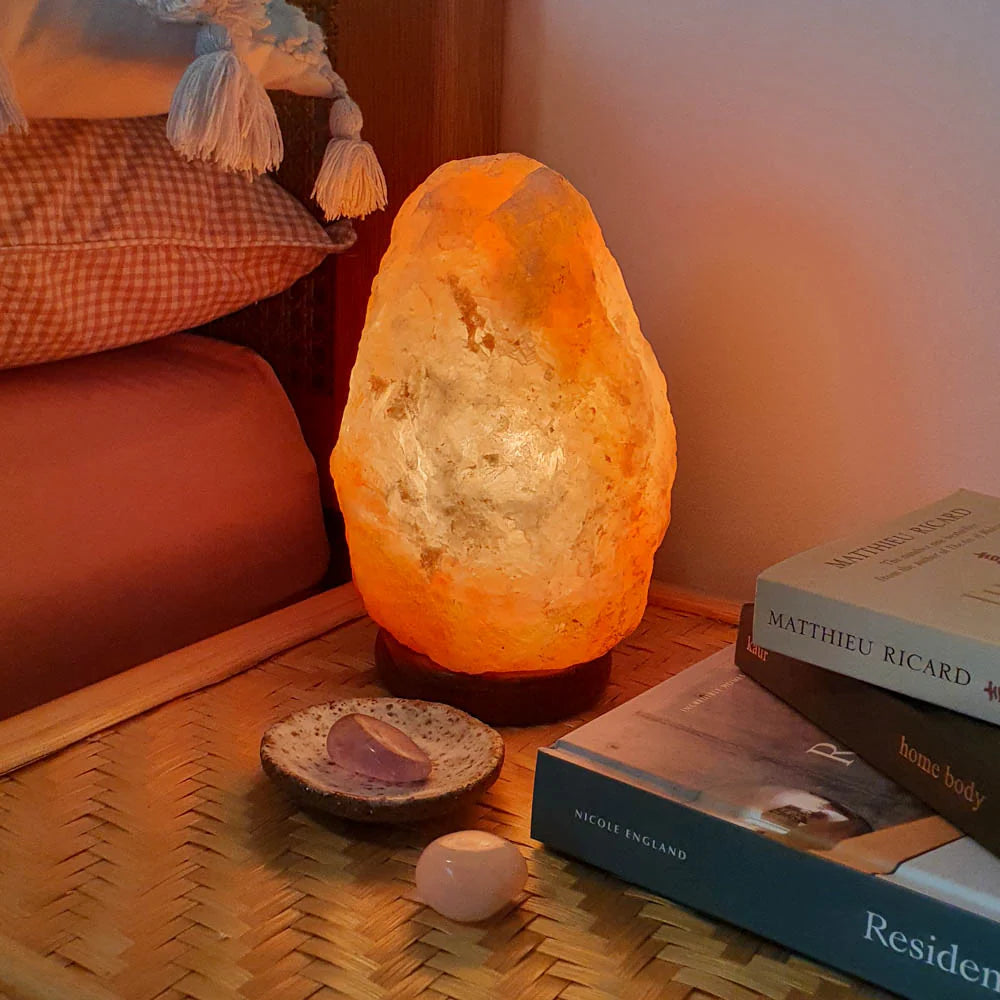
Salt lamp glowing in softly lit bedroom

Blue light, which is abundant in phone screens, overhead LED lighting, and computer monitors, suppresses melatonin production. Melatonin is the hormone that signals to your body that it is time to sleep. When you swap harsh overhead lighting for a warm amber glow in the evening, you reduce that suppression and support your natural sleep cycle. Sleep hygiene researchers value salt lamps primarily for this warm light effect, not for any ion-based claims.

The benefits you can genuinely expect from a USB salt lamp include:

  • Reduced blue light exposure in the hour before bed, supporting melatonin production
  • A calming visual atmosphere that signals to your brain that the day is winding down
  • Soft, non-intrusive lighting for evening reading, meditation, or yoga
  • Desk ambience during work hours to reduce the harshness of overhead office lighting
  • A decorative focal point that adds warmth and texture to any room

None of these benefits are unique to salt lamps specifically. Any warm, low-wattage amber light source would achieve a similar effect. But the natural texture and organic appearance of a salt crystal lamp adds something that a standard bulb does not: a visual quality that many people find genuinely soothing. That is not nothing. Aesthetics affect mood, and a space you enjoy being in is a space that supports your wellbeing.

Pro Tip: Place your USB salt lamp on your bedside table or desk and switch it on about an hour before you plan to sleep. Turn off your overhead lights and phone screen at the same time. This simple routine can make a noticeable difference to how quickly you fall asleep.

You can explore the natural USB multi-colour lamp from Thehimalayansalt if you want a lamp that lets you choose your preferred colour temperature for different moods and times of day.

Safety, maintenance, and choosing the right lamp

Before you buy, there are a few practical things worth knowing. USB salt lamps are generally safe, but the combination of salt and electricity does require some care.

  1. Check for electrical certification. Safety experts recommend choosing lamps with UL or equivalent certified components. Uncertified lamps from unknown sources can pose a risk, particularly if the USB cable or internal wiring is poor quality. Look for CE marking in the UK.

  2. Protect your surfaces. Salt is hygroscopic. In humid conditions, your lamp will absorb moisture from the air and may weep or leave a damp ring on wooden furniture. Always place the lamp on a coaster, a small tray, or a piece of slate. This is especially worth noting in bathrooms or kitchens.

  3. Keep it switched on regularly. A lamp left off in a humid room will absorb more moisture and may deteriorate faster. Regular use keeps the salt warm and dry.

  4. Handle with care. Salt crystals are brittle. Dropping your lamp, even from a short height, can chip or crack it. This does not affect function, but it will affect appearance.

  5. Choose the right wattage for your needs. A 3-watt lamp is very subtle and works best in a dark room. A 7-watt lamp gives a more visible glow in a lit space. If you want it as a night light, 3 watts is plenty.

  6. Read usb salt lamp reviews before purchasing. Genuine customer feedback will flag issues with cable quality, brightness levels, and durability that product descriptions often gloss over. Look for reviews that mention long-term use, not just first impressions.

When comparing a salt lamp vs USB lamp in terms of practicality, the USB version wins on portability and convenience. The mains version wins on brightness and impact. For a desk or bedside table, the USB format is the more practical choice. For a living room feature piece, consider a larger Himalayan salt ball lamp that makes a stronger visual statement.

My honest take on USB salt lamps

I’ve spent a fair amount of time around Himalayan salt products, and my view is this: USB salt lamps are genuinely useful objects that have been buried under a pile of exaggerated claims.

The air purification story is marketing, full stop. I’ve seen people spend money on salt lamps specifically because they believe it will help with allergies or air quality, and that money would be far better spent on a proper HEPA filter. The science is clear, and I think it does consumers a disservice to keep repeating claims that controlled testing has consistently disproved.

That said, I’ve found real value in using a USB salt lamp as part of an evening wind-down routine. The quality of light genuinely matters for sleep, and most people’s homes are far too bright in the hours before bed. A warm, low-wattage lamp on the desk or bedside table is a simple, low-cost way to shift that. What most people overlook is that the benefit comes from the light, not the salt. But the salt does make the lamp more pleasant to look at, and that counts for something.

My recommendation: buy one because you like how it looks and you want a warmer evening light source. Do not buy one expecting it to clean your air or cure anything. Set your expectations correctly, and you will find it a genuinely pleasant addition to your space.

— asad

Find quality USB salt lamps at Thehimalayansalt

Ready to add one to your space? Thehimalayansalt stocks a range of authentic, handcrafted Himalayan salt lamps built for both aesthetics and everyday use.

https://thehimalayansalt.co.uk

From compact USB models perfect for desks and bedside tables to larger statement pieces for living rooms, every lamp is made from genuine Himalayan salt. For a premium centrepiece, the large Himalayan salt lamp is a standout choice, and the full crafted salt lamps collection gives you plenty of styles and sizes to browse. Free shipping across the UK makes it even easier to get started. Shop now and find the right lamp for your space.

FAQ

What is a USB salt lamp exactly?

A USB salt lamp is a small Himalayan salt crystal lamp powered by a standard 5V USB connection, typically drawing 3 to 7 watts. It produces a warm amber glow and is designed for use on desks, bedside tables, and other small spaces.

Do USB salt lamps actually purify the air?

No. Scientific testing shows USB salt lamps emit fewer than 50 negative ions per cubic centimetre, far below the 10,000 ions per cubic centimetre needed for any measurable air purification effect. They do not reduce dust, allergens, or VOCs in a room.

Are USB salt lamps safe to leave on overnight?

Generally yes, provided the lamp has certified electrical components such as CE or UL marking. Place it on a moisture-resistant surface and buy from a reputable supplier to avoid poorly wired cables.

What is the best use for a USB salt lamp?

The best use is as an evening ambient light source. The warm amber glow at 1800 to 2200K reduces blue light exposure and supports melatonin production, making it a practical addition to a pre-sleep routine.

How is a USB salt lamp different from a standard salt lamp?

A USB salt lamp is smaller, lower wattage, and powered via USB rather than a mains plug. Standard salt lamps run at 15 to 25 watts and produce a stronger, brighter glow. USB versions are more portable but less visually impactful in larger rooms.

Prev post
Next post

Thanks for subscribing!

This email has been registered!

Shop the look

Choose options

The Himalayan Salt
Enter your email to Get 10% OFF on your order!
Don’t miss out!
Edit option
Back In Stock Notification

Choose options

this is just a warning
Shopping cart
0 items