

Salt Lamps In Interior Design: Principles That Work

A Himalayan salt lamp earns its place in a room through light, not through any health claim. Warm amber glow, low intensity, an organic crystal shape: that combination makes it a natural accent piece, the kind of small deliberate light that nudges a room from functional to inviting. This is salt lamps in interior design, looked at properly: what gives the crystal its character, how to use it as accent lighting, how to pair it with natural materials, how to build a focal point, and how to style it room by room and style by style. The honest framing stays the same throughout. These are decorative mood lighting, not air purifiers.
What Gives a Salt Lamp Its Character
Before you style one, it helps to know why a salt lamp reads as a natural object rather than an ordinary light. Rock salt carved mostly from the Khewra Salt Mine in Pakistan runs from pale blush pink through amber to deep terracotta, and since every piece is hand-carved, no two match. That variation is the reason our natural salt lamps each read a little differently on the shelf, and the whole reason a lamp is worth treating like a small sculpture.
The crystalline surface also handles light in a way smooth materials never do. Put a bulb inside a carved lamp and the warm glow diffuses through the translucent crystal into soft, uneven pools rather than a flat beam. That scattered glow is the signature of the whole look, and there's more on why it reads as craft in our piece on what makes salt lamps natural art.
Where Salt Lamps Fit in a Lighting Scheme
Good interior lighting is layered, not flat. Designers usually work in three layers: ambient light that fills the room from the ceiling, task light for a specific job like a desk or reading lamp, and accent light that sets mood and picks out features. A salt lamp belongs firmly in that accent layer.
Why it matters: one bright overhead light reads as practical, not warm. Drop in a low, warm accent, a salt lamp on a shelf or side table, and the room gains depth, a soft pool of glow that pulls the eye and makes the space feel considered. Used like this, the lamp does quiet emotional work, marking the shift from active to restful without you thinking about it. Handy habit: dim the brighter overheads when the lamp's on, so its warm glow can lead a small zone instead of getting swallowed by bright ceiling light.
Balancing Colour and Warmth
Salt lamps sit at the warm, amber end of the spectrum. The glow is low and orange-pink, not bright and white, which is exactly why it feels cosy after dark. On the design side, it comes down to contrast and balance:
- Warm against cool. A salt lamp shows best when it isn't fighting cold, blue-white light. Dim or kill the cool overheads and let the amber lead.
- Group it with candles, a low-watt table lamp or fairy lights and it deepens an already warm scheme rather than working against it.
- Amber against neutrals. That orange-pink tone stands out beautifully against white walls, pale wood and stone, softening an otherwise clinical palette.
The aim is to pull harsh cool light out of the parts of your home where you actually relax, and hand the room over to warmer, layered light.
Pairing Salt Lamps With Natural Materials
Think of the base and the surroundings as a frame for a piece of natural art. The crystal is the centrepiece; everything around it should back it up, not compete. Each material below brings something different to the pairing.
Wood
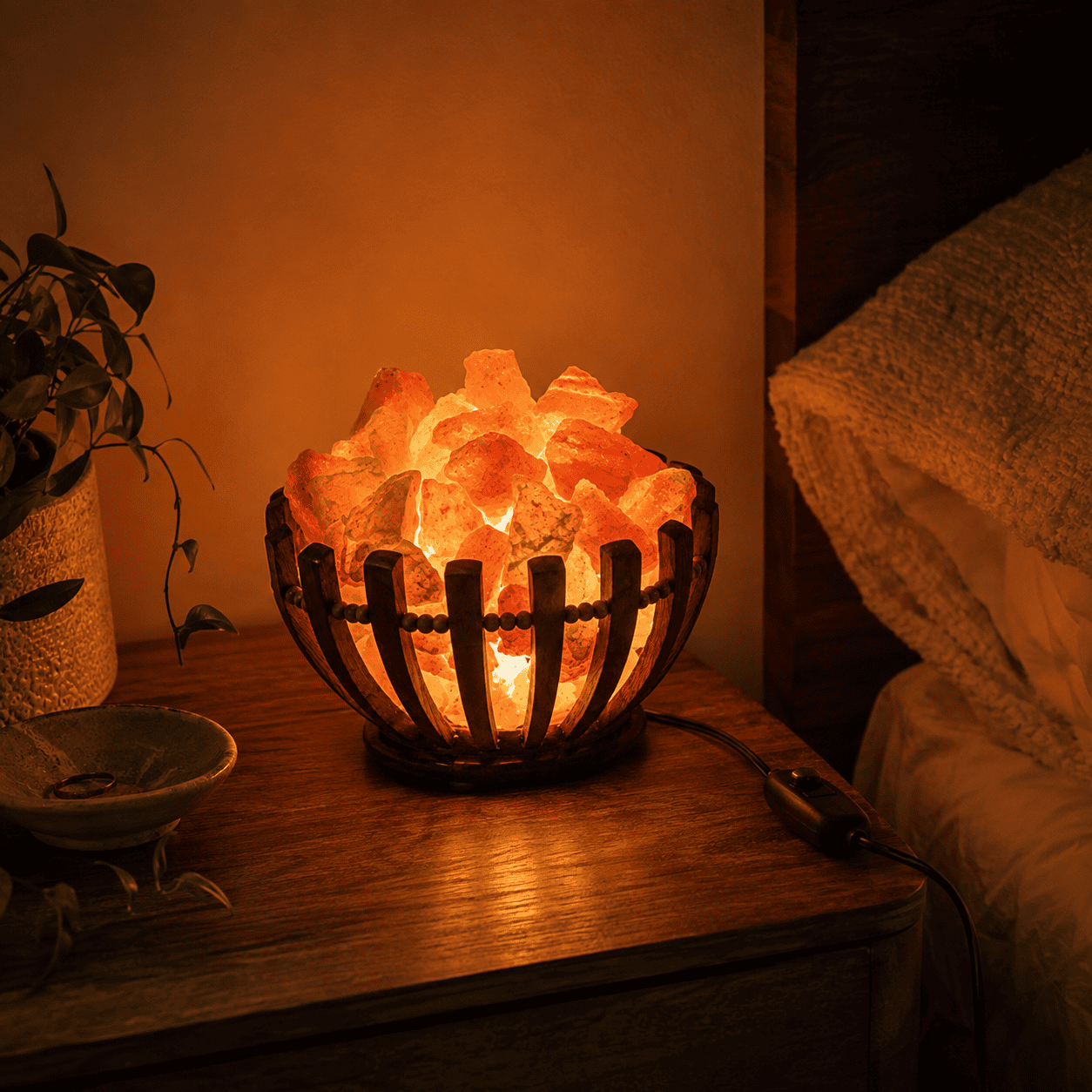
Wood is the most popular partner, and for good reason. A warm timber base, or a lamp set on a wooden shelf or console, echoes the amber in the salt and grounds the piece. Lighter woods suit minimalist and Scandinavian rooms; darker, redder timbers such as rosewood add depth. Wood is forgiving, easy to find, and works almost anywhere. That same wood-and-salt pairing is exactly what the wooden basket lamps lean on.
Stone and Marble
Set a salt lamp against stone or marble and you get a sharp contrast: polished, cool surface against rough, warm crystal. Dense stone bases also steady the larger, heavier lamps, where a lightweight base would feel precarious. That tension between smooth marble and raw salt is one of the most elegant pairings going.
Rattan and Wicker
Woven rattan, wicker and cane bring a light, airy texture that suits relaxed, bohemian and coastal looks. A salt lamp glowing beside a woven basket or on a cane console feels warm and unfussy, and the open weave catches the amber softly.
Ceramics
Matte, earthy ceramics, think stoneware vases, dishes or planters, complement the mineral quality of the salt. Neutral, handmade-looking glazes reinforce that natural, tactile feel and keep a grouping calm rather than busy.
Linen, Wool and Other Textiles
Soft natural textiles, linen runners, wool throws, cotton weaves, add warmth and stop a display feeling hard-edged. A linen runner under the lamp or a wool throw nearby ties the glow into a cosy, layered scheme.
Greenery and Plants
Foliage brings life and movement to a salt lamp corner. A trailing plant, a small succulent or a few dried stems soften the arrangement and reinforce that biophilic feel of natural light meeting living greenery.
| Material | Aesthetic effect | Best for |
|---|---|---|
| Wood | Warm, grounding | Almost any room; Scandinavian and rustic looks |
| Stone / marble | Cool, polished contrast | Larger lamps; modern, elegant schemes |
| Rattan / wicker | Light, textured | Boho and coastal corners |
| Ceramics | Earthy, tactile | Calm, minimalist groupings |
| Linen / wool | Soft, cosy | Layered, Hygge-style spaces |
| Greenery | Fresh, living accent | Biophilic, wellness corners |
Using a Salt Lamp as a Focal Point
Because no two salt lamps are identical, each has the character of a small natural sculpture. That individuality makes them well suited to being a modest focal point rather than blending in.
- Give it room. A lamp on an otherwise clear shelf, console or mantel commands more attention than one lost among ornaments.
- A small lamp vanishes in a large open room while a larger statement piece holds its own, so scale it to the wall or surface behind it.
- Consider the backdrop. Against a plain wall or a run of books, the glow and crystal texture stand out. Against a busy background, both get diluted.
- Use corners. Placed where two walls meet, the glow bounces off both surfaces and fills the space more evenly, making a larger piece feel even more present.
- Group two or three lamps of different sizes on one console, a taller natural crystal beside a shorter carved piece, and it reads as a considered arrangement rather than a stray object.
Styling by Room
Different rooms call for different placements. Matching the lamp's size and its surroundings to the scale of the room is what makes a display read as intentional. The table below is a practical starting point.
| Room | Suggested size | Placement idea |
|---|---|---|
| Bedroom | Small to medium (about 3 to 5 kg) | Wooden bedside table with a linen runner and a small plant, away from water, for a soft pre-sleep glow |
| Living room | Medium to large (about 6 to 12 kg) | Shelf, console or corner at seated eye level; group a few sizes for depth |
| Hallway | Small | Console table or ceramic dish for a warm, low-level welcome |
| Home office | Small (about 3 to 5 kg) | Desk corner on a rattan tray to soften the cool light of screens |
| Meditation or wellness corner | Medium | Stone or marble plinth with cushions, a ceramic dish and a trailing plant |
| Open-plan space | Large (15 kg and above) | Statement shelf or sideboard to anchor a zone |
| Reading nook | Small to medium | Low surface nearby for intimate, low-glare light |
Styling by Design Style
A salt lamp's organic form and warm tone slot into several established, nature-led looks. The common thread is natural materials used with restraint.
- Hygge: the cosy Danish aesthetic runs on warm, low light and natural texture, so a salt lamp is almost a default, especially beside candles, linen and wool throws for a wind-down feel.
- Japandi blends Japanese minimalism with Scandinavian warmth and favours restraint, natural timber and earthy ceramics; a single carved lamp on a clean wooden surface fits that pared-back palette without cluttering it.
- Biophilic: design that ties a home back to nature pairs a salt lamp with greenery, raw wood and stone, the warm glow anchoring the scheme.
- Rustic and bohemian: larger, irregular crystal shapes suit layered textiles, rattan and raw, earthy materials, adding a sculptural element.
A note on expectations: a salt lamp's design value is real, and it comes entirely from the warm, low light and the natural form. Decorative mood lighting, not an air purifier. Style it for atmosphere and enjoy it for the glow. Since it needs no installation and suits almost any interior, it also makes a thoughtful housewarming or wellness gift.
Practical Placement and Care Notes
A little care keeps a lamp looking its best. Pick a wide, stable base so it won't tip on a polished surface, and keep it clear of sinks, bathrooms and humidifiers, since salt draws in surface moisture. Run it for a few hours regularly so its own warmth keeps the surface dry, and use the manufacturer's recommended bulb wattage. Wipe the crystal with a dry or barely damp cloth and never soak it. Protect the surface underneath with a felt pad or cork mat, especially beneath a wooden or stone base, and keep textiles a little back from the base so they stay dry. Keep lamps out of reach of cats, which will lick the salt. Our care and maintenance tips cover upkeep in full.
Frequently Asked Questions
What is the role of a salt lamp in interior design?
Accent lighting. A warm, low glow that adds mood, depth and a natural focal point, sitting in the accent layer of a scheme alongside candles and low table lamps rather than replacing your main light.
What natural materials pair best with a salt lamp?
Wood is the most versatile partner, while stone and marble add contrast and steady the larger lamps. Rattan, ceramics, linen and greenery all complement the crystal and lean into a natural, biophilic feel.
Do salt lamps purify the air or have health benefits?
No. The value is decorative: warm ambience and a distinctive natural form, nothing to do with the air.
Which interior styles suit a salt lamp?
Warm, natural looks like Hygge, Japandi, biophilic and rustic or bohemian schemes suit them especially well, as do neutral and Scandi interiors where the amber adds warmth against pale backgrounds.
What size lamp should I choose for a room?
Match size to scale: a small lamp for a bedroom or desk, a medium one for a living room shelf, a large statement piece for an open-plan space so the glow isn't lost.
Find the Right Lamp for Your Room
For a smoother, more sculptural finish rather than a raw natural block, our crafted salt lamps are worth a look when you're matching a lamp to a scheme.
To layer in more warm light around it, a set of candle holders pairs naturally with a lamp. And to set the whole range in context, our ultimate guide to salt lamps covers types, benefits and home integration.