

What Makes Salt Lamps Natural Art: A Full Guide

Pick up two salt lamps of the same weight and you'll notice they don't match. One glows coral, the next runs darker and more amber, and the surface catches the light differently on each. That's the thing that makes salt lamps natural art rather than another lit-up ornament: the colour, the crystal texture and the hand shaping all come from a lump of ancient rock, not a mould. Each one sits closer to a mineral specimen than a factory accessory. We're looking at these lamps here as décor, with honest expectations about what they actually do.
What Makes Salt Lamps Natural Art: Origin and Geology
It starts underground, in the Khewra Salt Mine in Pakistan. Halite crystals formed there over millions of years as ancient seas dried up and compressed into rock. What comes out is dense and mineral-rich, nothing like quarried stone or moulded glass.
Himalayan pink salt is roughly 96 to 98 percent sodium chloride. The small remaining fraction is trace minerals, and it's those, chiefly iron oxide, that colour the salt. A single block can run from pale, almost white salt through blush pink and warm orange to a deep rusty red, often with visible bands, and the tone can shift from translucent white to amber within a couple of centimetres. Nothing is printed or dyed here. It's geology you can see, which is why real Himalayan salt looks uneven rather than a flat, uniform pink.
| Mineral element | Visual effect on the lamp |
|---|---|
| Iron oxide | Pink to deep orange colouration |
| Calcium | White or pale translucent patches |
| Trace minerals | Subtle grey, red-brown and amber depth |
Why Is Each Salt Lamp a Unique Piece?
The minerals never spread evenly through the deposit, so no two blocks share a colour map. One lamp glows soft coral. The next, cut from stone quarried a few metres away, carries darker veining and a richer amber. All of that is decided long before anyone picks up a tool.
Then there's the crystal structure inside. Salt grows in irregular lattices, so you get veins, fractures and shifts in density you can't read from the outside. A carver works with those lines rather than against them, which is why two lamps of the same nominal shape and weight still end up different in profile, texture and glow. If you want to see how far that variation runs before any carving happens, our look at how salt lamps are handcrafted from mine to home follows a block from the seam to the finished piece.
Three forces that make every lamp different
- Geological age. The salt formed over millions of years, and conditions varied across the deposit, so different seams carry different mineral signatures.
- Iron oxide and the other trace elements set the colour, anywhere from near-white through pink and orange to red, with banding that belongs to that block alone.
- Human craft. Hand carving and hand selection follow the salt's own fractures, so the shape and surface never repeat.
How Are Salt Lamps Crafted Into Natural Art Pieces?
This is the step where geology turns into something you'd put on a shelf. Artisans around Khewra pick raw blocks for colour, soundness and natural shape, then work each one by hand.
- Selection. Blocks get assessed for colour richness and whether the structure will hold together.
- Rough shaping. Loose or damaged sections are chipped off, keeping as much natural surface as possible.
- Hollowing. A cavity is cut into the base for a small bulb, with the walls kept an even thickness so light comes through evenly.
- Finishing. Natural-form lamps keep their rough texture. Sculpted styles get lightly smoothed but hold onto their crystalline character.
- Mounting. The block is fixed to a wooden base that steadies it and holds the fitting.
Keeping the natural edges while hollowing out room for the light is what leaves each lamp one of a kind. A deliberately sculpted form, like the shaped heart, ball and pyramid designs, shows the other side of it: a form can be imposed without stripping out the mineral character. The crafted salt lamps range runs the full spread from raw natural to fully sculpted.
Handmade craft versus cheap imitations
A genuine artisan lamp is prized because it's one of a kind, and you see that most clearly next to the mass-produced stuff. Plenty of cheap lamps are pressed from crushed salt powder in moulds, or made from synthetic material dressed up to look like crystal. Handmade ones are shaped from solid, unprocessed blocks, so they keep the contours of the original stone, and they usually sit on a solid wooden base with a decent cord. A hand-carved lamp has irregular facets and depth of colour a moulded copy can't fake.
| Feature | Handmade salt lamp | Mass-produced lamp |
|---|---|---|
| Material | Solid natural salt block | Crushed powder or synthetic |
| Appearance | Unique, irregular, natural colour variation | Uniform, predictable shape |
| Base and cord | Solid wood, quality cord | Plastic or low-grade fittings |
| Durability | Higher, solid construction | Lower, can crumble |
| Décor value | One-of-a-kind statement piece | Generic, interchangeable |
What Makes the Lighting Experience Unique?
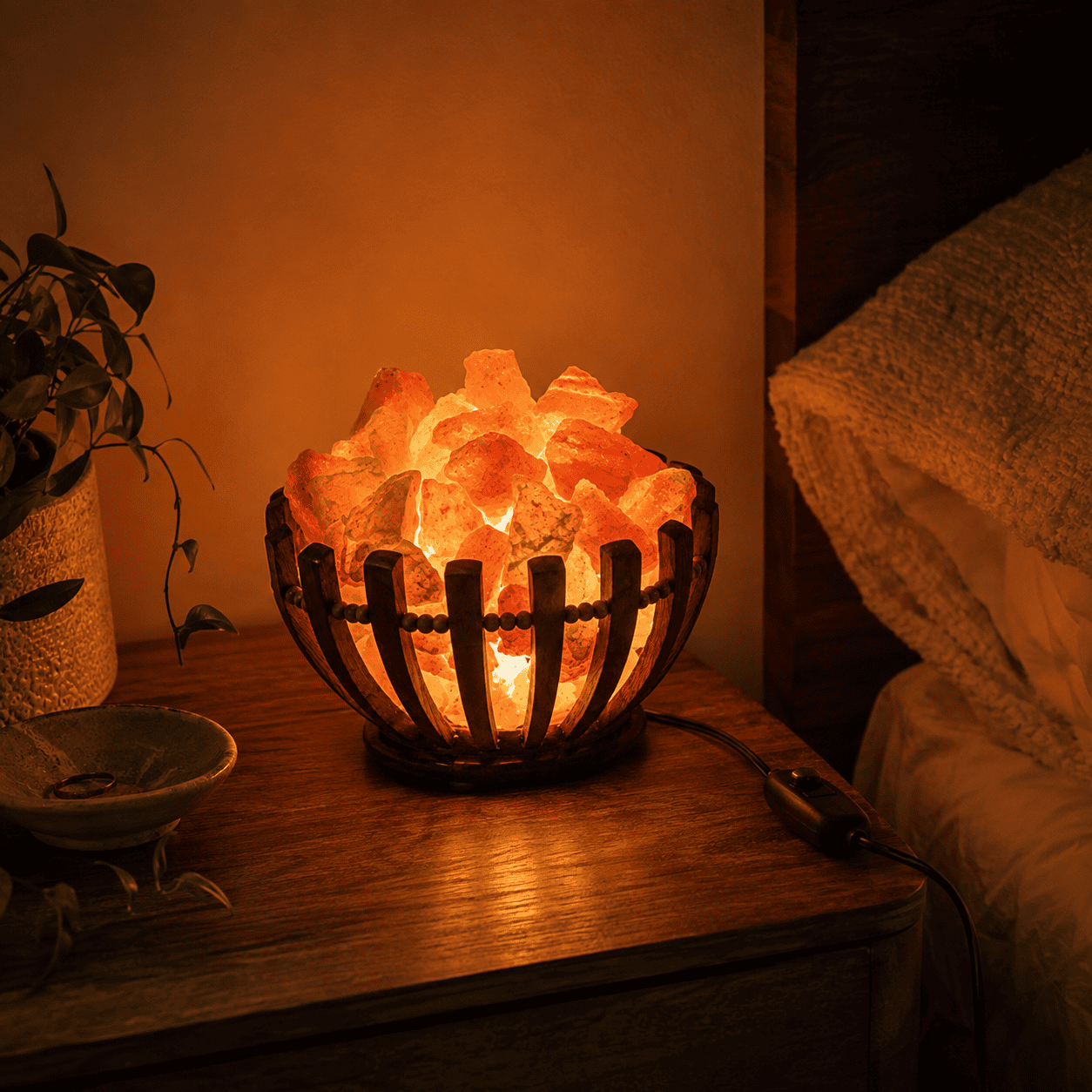
The glow comes from a bulb warming the salt from the inside, so the light travels through a mineral structure and scatters differently at every point on the surface. It isn't a coloured bulb behind frosted glass. Because the crystal is uneven and only semi-translucent, the thick, dense zones glow faintly while the thinner areas and fracture lines let more light through. You end up with a warmth that varies right across the piece.
The colour temperature lands in the warm amber range, well below the blue-heavy output of a standard LED or fluorescent. Easy on the eyes late in the day, which is why these lamps suit bedrooms and reading corners, a bit like candlelight. The lit surface gives off a gentle warmth too, and people tend to want to touch it. Worth being straight about one thing: that warmth and colour come from an ordinary low-wattage bulb behind coloured crystal, not from any special property of the salt.
An Honest Note on Health Claims
Salt lamps get marketed for air purification and negative ions, and we'll be plain about it: there's no credible evidence they meaningfully clean indoor air or release useful quantities of negative ions. The bulbs run at roughly 15 to 25 watts, far too weak, and room-scale testing shows negligible ion output and no real drop in dust or airborne pollutants. Salt does pull in a little surface moisture and dust, but that's localised, not room-wide filtration. Actual air cleaning needs airflow and dense filter media, which a decorative lamp hasn't got. If air quality genuinely worries you, run a certified HEPA purifier and let the lamp do the job it's good at, which is light. The calm people report is warm, low-stimulation lighting doing its work, and understood as ambience and décor that appeal is real.
How Do Salt Lamps Work as Natural Art in Home Décor?
Salt lamps settle into rooms built on natural materials, warm tones and texture you want to touch, next to wood, linen, stone and ceramic. A larger lamp on a sideboard or shelf pulls the eye without shouting over everything else, and the glow is soft enough to fade back once other lights come on.
The spread of size, colour and shape makes them properly personal. A cooler grey lamp suits Scandinavian-leaning rooms. A deep orange natural form suits warmer, rustic or bohemian spaces. A ball shape gives a clean, sculptural presence for minimalist settings. If you're arranging a whole corner around one, our notes on what really works with salt lamps in interior design go further on layering the light. Placement ideas:
- Bedrooms: a bedside lamp for warm evening light that suits a wind-down routine.
- Living rooms are where a larger lamp earns its place as a focal point on a shelf or console.
- Home offices: a smaller lamp to take the edge off screen glare.
- Calm corners, where warm light and natural texture together hold a grounded feel.
Set beside a piece of driftwood or a quartz cluster, both purely visual, a salt lamp adds light, warmth and a bit of presence. Functional sculpture, in the honest sense. Switch it on at the same point each evening and it quietly becomes part of winding down.
How to Spot a Genuine, Unique Lamp
Real rock-salt lamps carry a few markers that separate them from moulded or artificial copies.
- Uneven surface texture. Real salt is coarse and slightly irregular. A perfectly smooth, glassy finish should make you pause.
- Genuine rock salt shows lighter and darker zones inside the same block, not one flat hue.
- Weight relative to size. Salt is dense, so a lamp that feels surprisingly light for its size is worth a second look.
- A response to humidity. In a damp room a real lamp may pick up slight surface dampness, sometimes called sweating. Normal, and a decent sign the material is genuine.
- Verified origin and safe fittings. Look for genuine Himalayan salt from Pakistan rather than a vague "natural salt", on a solid wooden base with a CE-marked cord.
Choosing and Caring for Your Lamp
- Match size to the room. A 2 to 3 kg lamp suits a small bedroom. Bump up the size for a living room.
- Match the bulb sensibly. A low-wattage incandescent or halogen bulb gives gentle warmth and a good glow. Follow the maker's guidance on size.
- Keep it away from damp. Salt draws in moisture, so skip bathrooms, kitchens and windowsills in wet weather, and stand it on a tray or mat. Running it regularly keeps the surface dry, since the bulb's warmth drives off what it absorbs.
- Wipe, don't wash. A slightly damp cloth, then dry it straight away. Never rinse or submerge a salt lamp. It'll dissolve.
- Keep away from pets. Cats licking a salt surface can come to harm, so put lamps out of their reach.
Frequently Asked Questions
What makes a salt lamp different from a regular decorative lamp?
It's carved from a solid block of Himalayan rock salt, so the light sits inside a natural mineral object. The crystal scatters that light organically into a warm amber glow no manufactured shade copies.
What makes each salt lamp different from the next?
Different block, different mineral content, crystal structure and surface. No two blocks are alike, so no two lamps are.
Are the colours in Himalayan salt lamps natural?
Yes, entirely. The pink, orange and red come from trace minerals like iron oxide in the salt itself. Nothing is dyed, which is exactly why the colour looks uneven instead of a flat bright pink.
Why are handmade salt lamps more expensive than standard ones?
Hand carving from solid crystal takes labour and skill, the material has to be good, and every piece is one of a kind. That's what you're paying for.
Do salt lamps actually purify the air?
No. Their value is the light.
How can I tell if my salt lamp is genuine?
Coarse, uneven surface. Colour that varies within the same block. A weight that feels dense for the size. And if it picks up a little dampness in a humid room, that's real salt behaving exactly as it should.
Why does my salt lamp appear to sweat?
Salt pulls moisture out of the air, so light surface dampness in humid conditions is normal. Keep it switched on and the bulb's warmth drives that moisture back off.
Are salt lamps safe to leave on?
With a CE-marked cord and the right low-wattage bulb, extended use is generally fine. In humid rooms, keep it on a tray and check the cord for moisture now and then.
What interior styles suit a salt lamp best?
Natural, rustic, bohemian and Scandinavian rooms all take one well, sitting alongside wood, linen, stone and ceramic through the organic texture and warm glow.
Find Your Natural Salt Lamp at The Himalayan Salt
Every lamp we stock is worked from genuine mineral-rich rock salt out of the Khewra region, so you get real colour, real texture and real amber light. Have a look through the natural salt lamps, weigh up finishes with our guide to natural vs polished salt lamps, or get the whole picture in the ultimate guide to benefits, types and home integration.