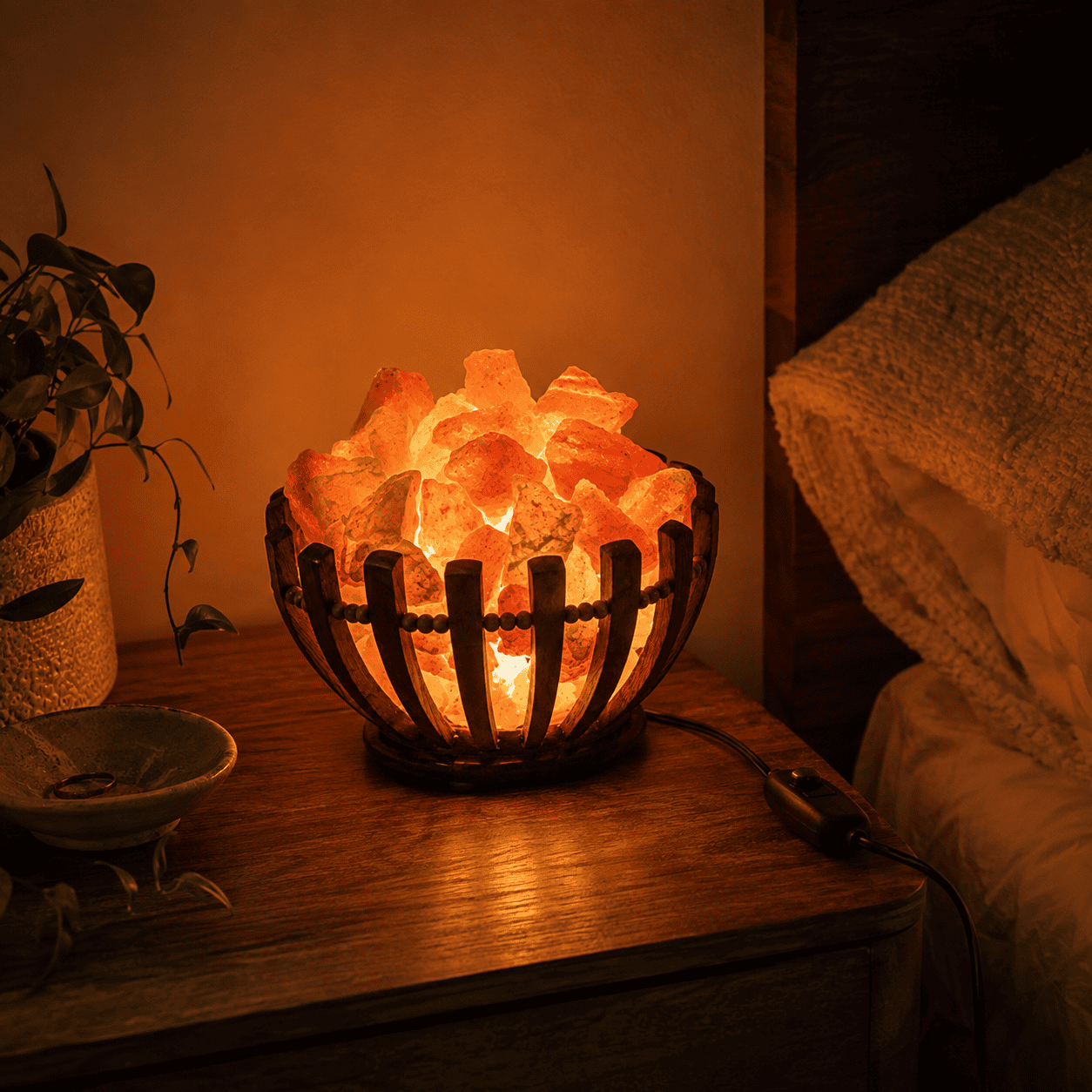


How Himalayan Salt Lamps Are Handcrafted: From Khewra Mine to Your Home

The warm glow of a Himalayan salt lamp starts deep underground, long before it reaches your shelf. Each lamp is carved from a single block of pink rock salt, and no two are ever quite the same. These aren't churned off a production line. A genuine lamp passes through a lot of hands, from the miners who cut the raw salt to the artisans who shape, drill, wire and finish each piece. Here's that journey, step by step, so you can see what makes a real handcrafted lamp and why it looks the way it does.
Where Himalayan Salt Actually Comes From
Despite the name, this salt isn't scraped off Himalayan peaks. Nearly all of it comes from the Khewra Salt Mine in the Punjab region of Pakistan, in the foothills of the Salt Range. Khewra is the world's second-largest salt mine and has been worked since 1872, though the deposit itself formed hundreds of millions of years ago, when an ancient inland sea slowly dried out.
That prehistoric origin is where the colour comes from. Trace minerals such as iron oxide tint the crystal pink, orange and amber, and because the mineral blend shifts from seam to seam, lamps run from pale rose to deep burnt orange. Only some of the mined salt is clear and solid enough to carve, so blocks are hand-picked for colour and soundness before they leave the mine.
Step 1: Mining the Raw Salt
Inside Khewra, large blocks of rock salt are cut from the seams and sorted by hand. Graders look for pieces that are dense, richly coloured and free of major fractures, because a block with a hidden crack can fail later, under the tools or in daily use. The best boulders are set aside for decorative lamps. Lower grades go to salt bricks, tiles and edible salt instead.
Step 2: Hand-Selecting and Sorting Blocks
At the workshop the salt gets sorted again. Some blocks are headed for the natural-shape lamps that keep their rough, craggy outer surface largely intact, so the piece looks like a glowing chunk of raw crystal. Others are picked for carved shapes, spheres, pyramids, bowls and geometric forms, which need cleaner, more even salt. This is the stage where a lamp's character gets decided.
Step 3: Carving and Shaping
Shaping is the heart of the craft, and it's nearly all done by hand with simple tools: chisel, grind, smooth.
- Natural lamps get their base levelled and the surface lightly cleaned, but the rugged texture stays.
- Carved lamps are worked with chisels and grinders, then smoothed down until the surface glows evenly when lit.
Salt is a natural crystal, not a manufactured material, so every block behaves a bit differently under the tools. That's exactly why each finished lamp is one of a kind in colour, shape and internal veining, and why small variations point to authenticity rather than a fault. If you're weighing rugged against smooth, our comparison of natural versus polished salt lamps gets into how each finish looks and cleans.
Step 4: Drilling the Cavity for the Bulb
Next, a cavity is drilled up into the base to hold the bulb holder and cord. It has to be deep and wide enough to seat the fitting securely while leaving enough solid salt around it to glow warmly and stay strong. Drilling salt takes a careful touch. Too much force and the block cracks, so this goes slowly, checked as it goes.
Step 5: Fitting the Base
The lamp is then fixed to a stable base, usually turned wood, which gives it a flat, secure footing and hides the electrical fitting. The base also lifts the salt slightly off the surface it sits on, which helps protect furniture from any moisture the salt draws in. A well-fitted base is what keeps a lamp sitting level instead of rocking.
Step 6: Wiring, Bulb and Cord
With the base on, the electricals go in: bulb holder, cord, switch and the bulb itself. Reputable makers use fittings that meet the safety standards for the market they're sold into. Most lamps pair with a low-wattage incandescent or candle bulb, usually around 15 to 25 W, which gives the gentle warmth and soft amber glow the lamp is prized for. That heat earns its keep in daily use too, since keeping the lamp lit limits the "sweating" you'll see in humid weather.
Step 7: Cleaning and Quality Control
Finally, each lamp is cleaned and checked. Artisans brush off salt dust, make sure the base sits flat, test the light and look for deep cracks or wobble. Only then is it packed, usually with a bulb, cord and care instructions. This is where packaging earns its keep. A salt lamp is the heaviest fragile thing we ship, and no matter how much padding goes in, a courier will occasionally still crack one in transit, which is why the good workshops box them like they expect a rough ride.
The Journey at a Glance
| Stage | What happens | Why it matters |
|---|---|---|
| Mining | Salt blocks cut from Khewra seams and sorted | Selects dense, well-coloured salt |
| Hand-selecting | Blocks split into natural vs carved | Decides each lamp's shape and style |
| Carving | Chiselling, grinding, smoothing by hand | Creates the form and glow; makes each unique |
| Drilling | Cavity drilled for the bulb holder | Seats the fitting; keeps salt strong |
| Base fitting | Wooden base attached | Stability and furniture protection |
| Wiring | Holder, cord, switch and 15 to 25 W bulb added | Safe operation and warm glow |
| QC and packing | Cleaned, tested, inspected, boxed | Ensures a safe, sound lamp arrives intact |
How to Spot a Genuine Handcrafted Lamp
A few honest tells separate a real hand-made piece from a mass-produced imitation:
- Natural variation. Colour, veining and shape differ lamp to lamp. Perfectly identical lamps are a red flag.
- Solid rock salt is heavy, so a lamp that feels light for its size may be hollowed out or not solid salt.
- A secure base and quality fittings. A flat, well-attached base and safety-marked electricals show care in assembly.
- Natural lamps keep their rugged crystal surface; carved ones show smooth, hand-finished faces rather than a plastic sheen.
You'll see both finishes across our crafted salt lamp range, where the carved spheres, pyramids and bowls show off the smoothing work described above.
Caring for Your Handcrafted Lamp
Your lamp is natural salt, so it draws moisture from the air. In damp conditions it can look like it's sweating or leave a little dampness on the base. Keep a low-wattage bulb in it and keep it lit regularly, so the gentle warmth holds the surface dry. Wipe only with a dry or barely damp cloth, and steer clear of humid rooms like bathrooms. Our full salt lamp care and maintenance tips go further on this.
Frequently Asked Questions
Are Himalayan salt lamps really handmade?
Yes. Real ones are hand-carved from rock salt blocks, then individually drilled, based, wired and finished. That hand process is why each is unique.
Where does the salt actually come from?
Almost all of it from the Khewra Salt Mine in Punjab, Pakistan, the world's second-largest, where the deposit formed from an ancient evaporated sea.
Why do two lamps look so different from each other?
Every block carries its own colour, mineral content and crystal structure, so shade, veining and shape vary naturally from one to the next. That's the hallmark of a genuine handcrafted piece.
Bringing the Craft Home
A Himalayan salt lamp is a small piece of natural history, shaped by hand from salt older than recorded time. Knowing the journey from the Khewra mine to the finished lamp makes it easier to pick a genuine, well-made piece. For the wider view on types, sizing and styling, our complete salt lamp guide ties it together, and if you're unsure how big to go, we cover choosing the right salt lamp size for your room separately.