

Salt Lamp Shapes: Heart, Ball, Pyramid, Angel and More

Himalayan salt lamps are loved for their warm amber glow, but the shape one is carved into changes its character completely. Where a raw crystal looks rugged and organic, a shaped Himalayan salt lamp, cut into a heart, a smooth sphere, a crisp pyramid or an angel, becomes a deliberate piece of design. Each is still hand-carved from natural salt, so it keeps the pink-orange tones, but the sculpted form adds meaning, a cleaner silhouette and a more even glow. That's why shaped lamps are so popular for gifting and for anyone who wants their lighting to double as décor.
Here we cover what a carved salt lamp is and how it's made, run through the full catalogue of shapes, look closely at the most popular designs, and get into choosing, styling and caring for one, with an honest note on what these lamps can and can't do.
What Is a Carved Salt Lamp and How Is It Made?
A carved salt lamp is a block of natural Himalayan rock salt, hand-shaped by an artisan and fitted with a small light inside, giving a warm, amber glow. It starts as a large block of raw salt from the Khewra Salt Mine in the Punjab region of Pakistan, where ancient seabeds left mineral-rich deposits hundreds of millions of years ago. The pink, orange and red tones come from trace minerals such as iron oxide; Himalayan pink salt is roughly 96 to 98% sodium chloride, with those trace minerals making up the small remainder.
Artisans shape each block by hand, hollow out a central chamber for the fitting and bulb, then finish the outside to a smoother, sculpted surface. That finish is what separates a carved lamp from a raw natural-chunk lamp, which keeps its rough, uncut face. Because the work is done by hand and the salt carries its own veining and colour, no two lamps are ever truly identical, and a symbolic shape like a heart or an angel carries meaning a raw chunk can't, which is why shaped lamps turn up so often as gifts. The whole shaping process, from mined block to finished piece, is covered in our guide to how salt lamps are handcrafted from mine to home.
Authentic Himalayan salt is traditionally mined in the Khewra Salt Mine region of Pakistan, and it is this natural mineral content that gives every lamp its signature pink-orange colouring.
Carved vs Natural Salt Lamps: What's the Difference?
The core difference is finish. A natural lamp keeps its raw, jagged, mined surface. A carved lamp is sculpted into a defined shape with a smoother face and a more even, predictable glow. Both use the same authentic salt, so the choice is purely about looks, not quality or function. If you're deciding between the two, our natural versus polished comparison weighs them up in detail.
| Feature | Carved (shaped) lamp | Natural (rough) lamp |
|---|---|---|
| Surface | Smooth, sculpted, defined form | Rough, irregular, uncut |
| Look | Refined, ornamental | Rustic, organic |
| Light | Even, predictable glow | Irregular, cave-like glow |
| Best for | Gifting, styled interiors | Natural, rustic spaces |
The Full Salt Lamp Shape Catalogue
Salt lamps come in a surprisingly wide range of forms, in two broad families: natural rough shapes that keep their mined character, and carved or geometric shapes cut to a defined form. Here's what you're most likely to meet.
Natural (rough) forms
Made from raw salt with minimal cutting, so each keeps its irregular, craggy character and no two match. The uneven faces scatter light in every direction for a warm, flickering effect smoother lamps can't match, and because less material is removed, they feel dense and substantial for their size.
- Natural rough chunk. The classic: a single raw crystal on a base, trimmed just enough to sit securely.
- Cluster. Several smaller crystals grouped on one base for a multi-directional glow.
- Freeform sculpture. A larger, artistically irregular piece meant as a statement object.
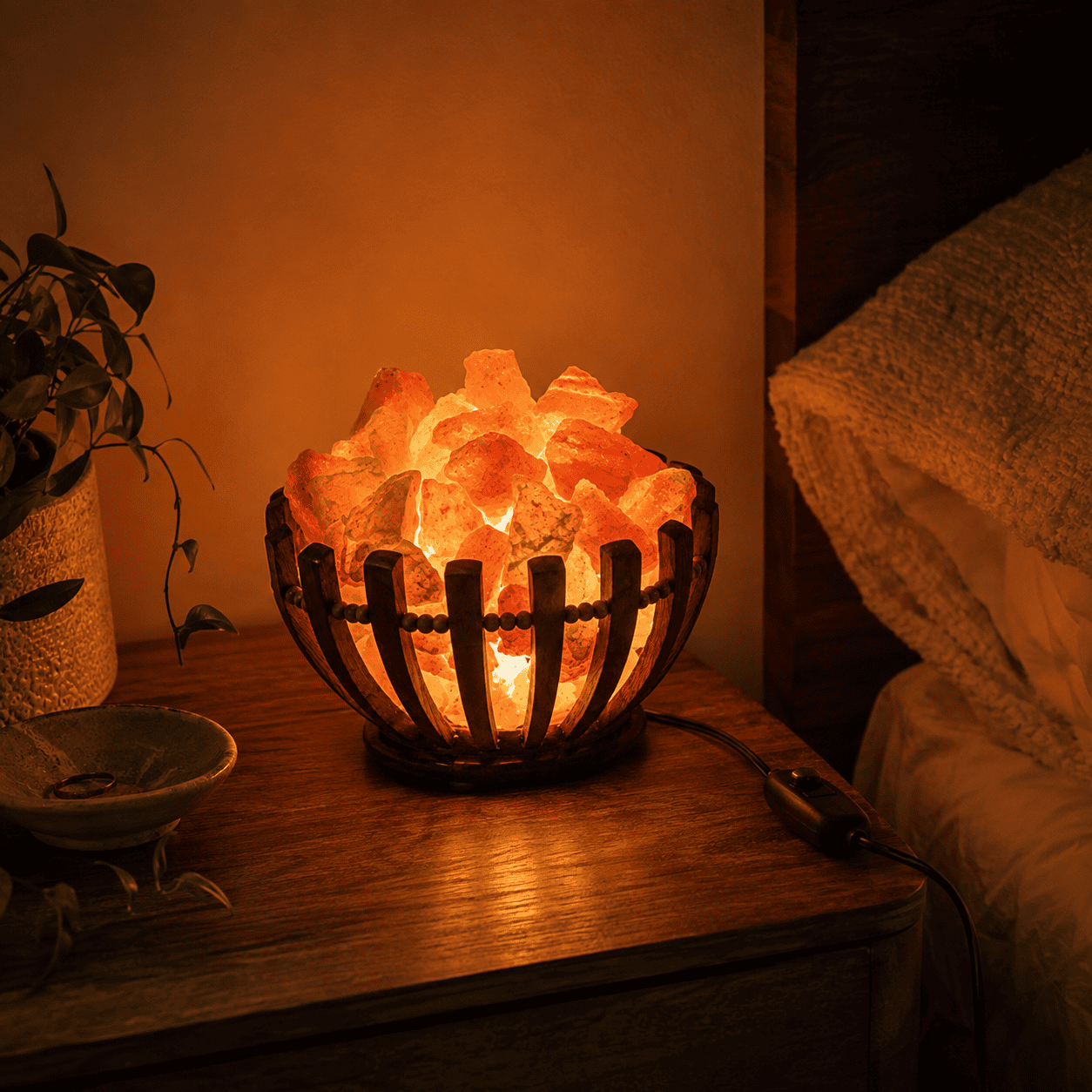
- Basket lamp. Loose salt chunks in a wooden or metal basket, rugged and textured through the frame.
Carved and geometric forms
Carving removes material to make a defined form, geometric or figurative, giving a cleaner, more uniform glow than a rough chunk while letting you pick a shape with a specific look or meaning.
- Sphere or ball. Spreads light evenly in all directions; one of the most popular carved forms.
- Pyramid. A four-sided form that sends a soft glow upward, good on modern desks and shelves.
- Heart. A gift-friendly, symbolic shape that suits bedrooms and personal spaces.
- Angel. A figurative shape carved as a standing or kneeling angel, popular as a sympathy or keepsake gift.
- Bowl or fire bowl. A carved bowl holding loose chunks around the bulb, so light glows up through the pieces.
- Obelisk or tower. Tall and slender, drawing the eye up, good on narrow surfaces.
- Cube. A clean, architectural block for minimalist and contemporary rooms.
- Geometric and figurative. Diamonds, cylinders, leaves, flowers and tree motifs bridge natural and carved styles.
Shape affects the light more than colour does, but it's purely aesthetic and lighting. It doesn't change what a lamp does, which is give gentle, decorative light. The table below lines up the common forms.
| Shape | Light character | Style it suits | Good for |
|---|---|---|---|
| Natural rough chunk | Warm, irregular, flickering | Rustic, bohemian, Scandinavian | Living room focal point |
| Cluster | Multi-directional | Rustic, natural | Side tables, layered lighting |
| Sphere / ball | Even, all-round | Modern, minimalist | Bedrooms, offices |
| Pyramid | Concentrated, upward | Contemporary | Desks and shelves |
| Heart | Soft, even | Personal, decorative | Bedrooms, gifts |
| Angel | Soft, even | Sympathy, keepsake | Shelves, memorial gifts |
| Bowl / fire bowl | Glow through loose chunks | Rustic, eclectic | Coffee tables, mantels |
| Obelisk / tower | Tall, upward accent | Modern, architectural | Narrow surfaces |
| Cube | Clean, even | Minimalist | Contemporary shelving |
| Basket lamp | Textured, broken up | Rustic, industrial | Hallways, feature corners |
Heart, Ball, Pyramid and Angel: The Top Picks Compared
Of all these forms, four carved designs dominate the shortlist for gifting and styled interiors.
Heart
The most sentimental of the shaped lamps, and exactly why it's such a popular gift. It reads instantly as a token of affection, a natural pick for Valentine's Day, anniversaries, weddings or a thoughtful gesture for a close friend. Often a smaller, lighter form, easy to place and easy to gift.
Ball and sphere
A spherical lamp spreads its glow evenly in every direction for a soft, moon-like light that feels calm and balanced. The smooth carving is what makes that even spread possible, and the rounded, hazard-free silhouette suits shared spaces, meditation corners and reading nooks.
Pyramid
The most architectural of the group. Clean lines and symmetry appeal to anyone who likes geometry and structure, and the shape carries a long-standing sense of stability and focus in many cultures. A genuine conversation piece that anchors a desk or shelf.
Angel
A figurative carve, usually a standing or kneeling angel, that reads as a keepsake or sympathy gift rather than everyday décor. The soft, rounded form diffuses light gently and suits a quiet shelf or memorial corner.
| Shape | Character | Best suited to | Gifting appeal |
|---|---|---|---|
| Heart | Sentimental, personal | Bedrooms, gift corners | Romantic occasions, close friends |
| Ball / sphere | Calm, balanced | Living rooms, wellness spaces | Meditation and yoga lovers |
| Pyramid | Structured, modern | Home offices, shelves | Housewarmings, design fans |
| Angel | Gentle, reflective | Quiet shelves, memorial spaces | Sympathy and keepsake gifts |
How to Choose the Right Shape for Your Room
Shaped lamps slot into almost any style, minimalist, bohemian or traditional. Once you know the forms, matching one to a room is easy.
- Living room. A large natural chunk or freeform sculpture makes a striking focal point, a cluster on a side table adds layered warmth, and a sphere suits softer, organic schemes.
- Bedroom. A sphere or heart gives a soft, even glow that suits a relaxing space and makes a thoughtful gift.
- Home office. A pyramid or cube adds warmth without clutter and takes the edge off harsh screen light in the evening.
- Feature corner. An obelisk or basket lamp works where you want height or texture without a big footprint.
- Small spaces. A compact carved shape sits neatly on shelves and windowsills where a large chunk would dominate.
Two styling habits help whatever the room. Pair the lamp with complementary materials, natural wood, marble or a matte black stand, to sharpen the contrast and let the amber glow stand out. And layer your lighting, combining the lamp with candles, fairy lights or a dimmed lamp for a cosy, multi-level glow rather than one hard source. The base matters here too: because salt draws moisture, a wider, low-set base gives larger lamps stability and protects the surface underneath, while warm wood suits rustic chunks and a sleeker stone or matte base suits carved geometric shapes. On occasion, shape and moment line up directly: heart-shaped lamps for Valentine's Day and anniversaries, pyramids for housewarmings, sphere and angel designs for wellness or sympathy gifts.
Buying Tips for Shaped Salt Lamps
To land an authentic, well-made lamp, keep these in mind.
- Verify authenticity. Genuine Himalayan salt has a slightly grainy texture and natural colour variation, not a flawless, plastic-like uniformity.
- Check the carving. On a shaped lamp the surface should be smooth and even, with no rough tool marks or chipped edges spoiling the form.
- Think about size. Smaller lamps of 1 to 3 kg suit bedside tables and desks, while pieces of 5 kg and above work as room focal points, casting a broader glow.
- Consider the power source. Some lamps use a mains plug, others come with USB connections for desks and travel, worth choosing deliberately based on where the lamp will live.
- Choose your bulb and check safety marks. An incandescent bulb gives a warmer glow and gentle heat, an LED stays cool and lasts longer. Use the wattage the maker specifies, and check the cord and fitting for UK safety marks (CE or UKCA).
Care and Maintenance
Because salt draws moisture, managing damp is the biggest part of ownership. In humid rooms the surface can dampen and leave a salty residue beneath the lamp. Normal, not a fault.
- Stand it on a protective mat or tray so salt residue and moisture don't reach wooden furniture.
- Keep it in a dry room such as a bedroom, living room or office, and avoid bathrooms, kitchens and conservatories.
- Leave it switched on when you can, since the bulb's gentle heat evaporates absorbed moisture and keeps the surface dry between cleans.
- Wipe gently with a dry or barely-damp cloth, then dry the surface straight away, and never submerge a salt lamp in water.
An Honest Note on Wellness Claims
Shaped salt lamps get marketed as air purifiers or sources of beneficial negative ions. The honest position: there's no credible scientific evidence for either. A 15 to 25 watt bulb is far too weak to ionise a room or clean the air, and independent testing puts the output at negligible. A lamp "sweating" is just salt attracting water from the atmosphere, not trapping pollutants. If clean air is the goal, a certified HEPA purifier is the right tool. What these lamps genuinely deliver is a warm, calming glow, typically in the 2,000 to 2,700 Kelvin range and low in blue light, a softer alternative to harsh light, and an attractive object. Buy one for its ambience, symbolism and design. For the full picture, read our explainer on whether salt lamps really purify the air.
Frequently Asked Questions
What is a carved salt lamp made from?
Natural Himalayan rock salt from the Khewra Salt Mine in Pakistan. An artisan hand-shapes the block and hollows it for a bulb, so every piece is one of a kind.
Which shaped lamp makes the best gift?
Depends on the occasion. A heart for romance and close friends. A sphere for anyone with a wellness or meditation habit. A pyramid as a strong, gender-neutral pick for housewarmings and design lovers. An angel for sympathy or keepsake gifts. All are still hand-carved from natural Himalayan salt.
Do shaped lamps glow differently from natural ones?
Yes, subtly. A smooth carved surface spreads light more evenly and predictably; a raw crystal scatters it for a more rustic effect. Neither is brighter or better.
Are shaped salt lamps fragile?
They're salt, so they can chip if dropped or knocked, and carved points like the tip of a pyramid or an angel's wing deserve extra care. Kept stable and away from damp, a shaped lamp lasts for years.
Final Thoughts
A shaped Himalayan salt lamp is as much an object of design as a source of light. Drawn to the sentiment of a heart, the calm of a sphere, the structure of a pyramid, the quiet of an angel, or one of the many other forms, each brings warmth, character and a talking point, and each makes a memorable gift. Set the wellness claims aside; the glow and the craftsmanship speak for themselves. Browse our crafted salt lamps to compare shapes, or explore the wider natural salt lamp range for a rawer look.