

How to Choose Salt Wellness Products: A UK Buyer's Guide

Salt wellness used to be a niche thing. Now it's on shelves and bedside tables across the UK: a glowing salt lamp in the corner, pink salt in the grinder, a bag of bath soak for a Friday night. The trouble is the number of sellers and the number of competing claims, which makes a simple purchase surprisingly hard to get right. This guide takes an honest look at the main kinds of salt wellness products, what they actually give you, what to be sceptical about, and how to spot a supplier worth trusting. We'll keep the expectations realistic and say where we fit as a UK option.
The main types of salt wellness products
"Salt wellness" covers a lot. Most of it falls into three practical categories, each with its own job and its own sensible level of expectation.
Himalayan salt lamps and décor
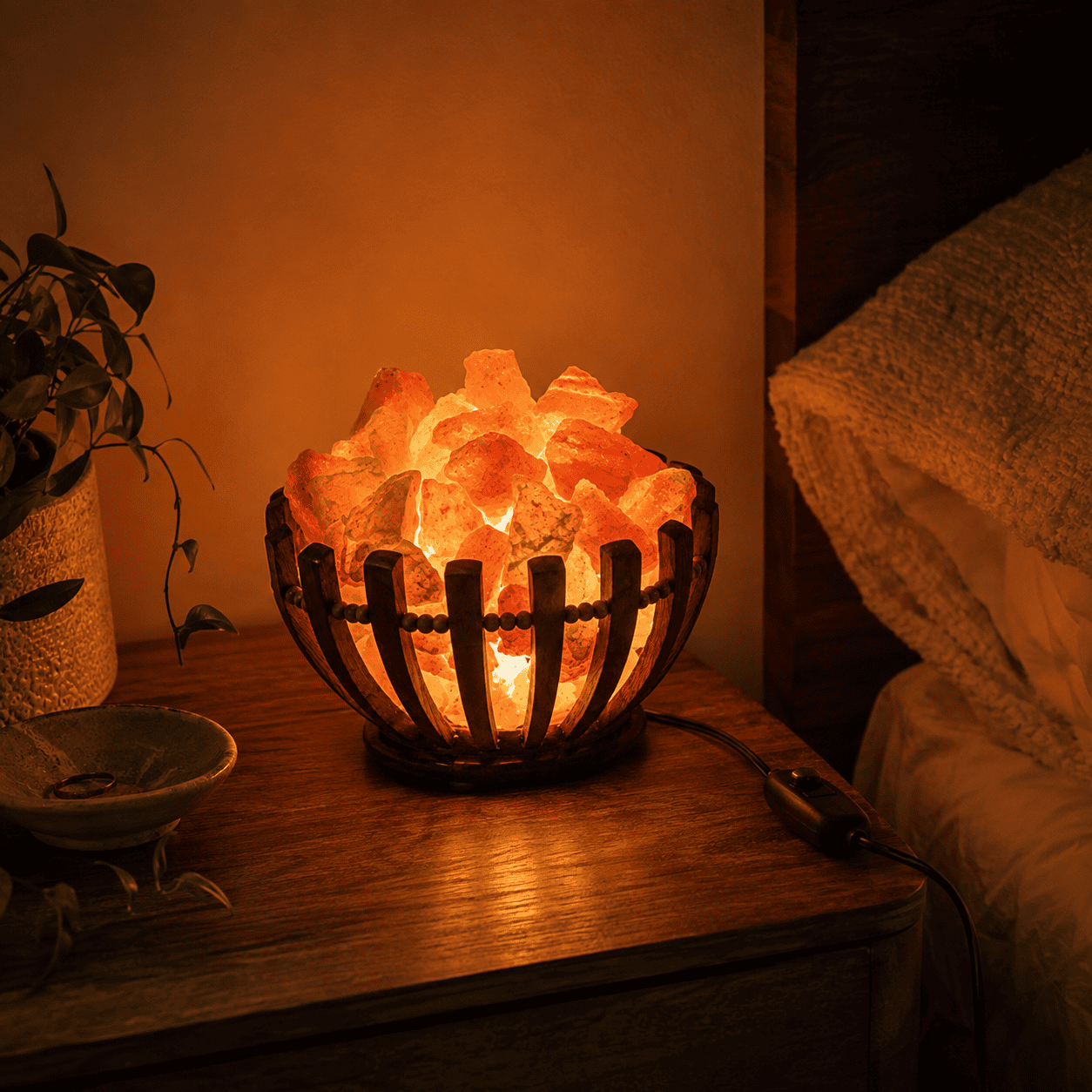
A salt lamp is a carved or basket-held piece of natural Himalayan pink salt with a small bulb inside it. The honest benefit, the one that holds up, is atmosphere: a warm amber glow people find calming, and lovely as low evening light. Here's the part sellers gloss over. There's no credible scientific evidence that salt lamps purify air or throw off meaningful negative ions. A household bulb is far too weak, and whatever ion output there is sits nowhere near the level that would change a room. Buy a lamp for the ambience and the décor and you'll be happy with it. If you want the deeper dive on how these get made and where they suit a home, our ultimate guide to Himalayan salt lamps goes further.
Edible Himalayan pink salt
Pink Himalayan salt is a natural rock salt, roughly 96 to 98% sodium chloride, with a small fraction of trace minerals giving it that colour. Those minerals show up in nutritionally minor amounts, and the iodine content is negligible, so it isn't a mineral supplement in any useful sense. Gram for gram the sodium matches ordinary table salt. Where it earns its place is the cooking: the colour, a nice texture for finishing a dish, coarse crystals for the grinder or fine grains for everyday use. Same rule as any salt applies, the NHS advises adults have no more than 6 g a day and the World Health Organization suggests under 5 g.
Spa and bath salts
Bath and massage salts are for a relaxing soak or spa-style treatment at home. A warm salt bath feels soothing and makes a genuinely pleasant ritual, but be cautious with the bigger therapeutic claims, since the evidence behind them is thin. Buy these for comfort, not as a remedy. Our spa and massage collection is the range we'd point you to for exactly that.
What to look for in a salt wellness supplier
The category matters, but so does who you hand your money to. A handful of things separate a good supplier from a frustrating one.
| What to check | Why it matters | Good signs |
|---|---|---|
| Honest claims | Overstated health promises are a red flag for the whole listing | Realistic language; benefits framed as ambience or culinary, not cures |
| Clear product detail | Salt weight, size and bulb wattage affect what you actually receive | Dimensions, weight ranges and care guidance stated up front |
| Transparent shipping | Unexpected delivery costs and delays are a common complaint | Clear UK delivery terms and timescales |
| Range and choice | One shop covering lamps, edible salt and spa salt saves time | A coherent catalogue across categories |
| Genuine sourcing | Authentic Himalayan salt is mined at Khewra in Pakistan | Clear provenance without exaggerated marketing |
Matching products to how you'll use them
What's right depends entirely on what you want out of it.
- For a calming home glow: a carved or basket salt lamp on a bedside table, shelf or side table for warm evening light.
- Kitchen use points to edible pink salt in coarse or fine grades, picked for colour, texture and everyday cooking rather than any nutritional edge.
- For relaxation: bath and massage salts for a soak, treated as a comfort ritual.
- A gift is easiest as a small lamp or a salt gift set, tactile and hard to get wrong, especially where free UK delivery keeps it simple.
Where The Himalayan Salt fits
We're a UK specialist that brings these categories under one roof, with free UK shipping across the range. Handcrafted and natural salt lamps for décor, edible pink salt for the kitchen, spa and massage products for winding down, all through a single checkout. We try to describe things straight: lamps sold for their warm glow and design, edible salt for its character in the kitchen, no inflated health claims. If you'd like the broader picture on picking and gifting salt products, our buying and gifting guide for Himalayan salt products covers the whole spread, and for the wellness side specifically there's our take on salt baths, detox talk and daily routines.
Honest note: salt lamps are decorative lighting, not air purifiers, and pink salt is a table salt with minor trace minerals rather than a supplement. Enjoy these products for what they genuinely offer.
Frequently asked questions
Do salt lamps really clean the air?
No. The glow is the point, not the air.
Is pink Himalayan salt healthier than table salt?
Not really. It's around 96 to 98% sodium chloride with only minor trace minerals and negligible iodine, and the sodium per gram is the same as table salt. Enjoy it for colour and texture, and stay within the usual salt limits.
How much salt should I use each day?
The NHS puts the ceiling at 6 g of salt a day for adults, and the World Health Organization recommends under 5 g. Pink salt counts towards that total exactly like any other salt does, so it doesn't buy you extra headroom.
What should I prioritise when choosing a supplier?
Honest claims, clear product details, transparent UK shipping, a coherent range. A shop that won't overpromise on health is usually the one to trust.
Choosing with confidence
Salt wellness products add warmth, flavour and a bit of calm to a home, as long as you buy them for what they really do. For a UK option that keeps its promises modest, our natural salt lamps and edible salt range are the place to start.