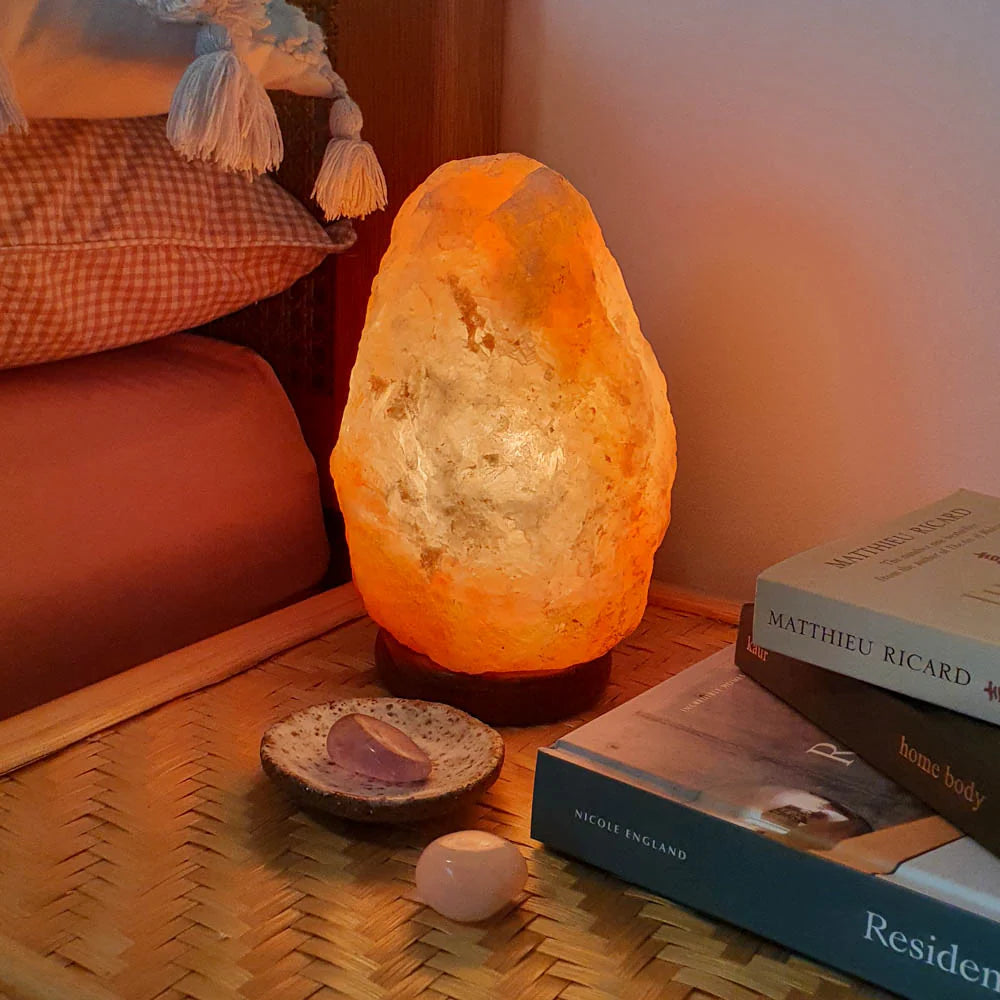


Buying and Gifting Himalayan Salt: How to Choose Authentic Products
Every winter we get the same email: someone bought a "Himalayan" salt lamp cheap somewhere else, it arrived a flat neon pink, and now they're not sure it's the real thing. It usually isn't. Genuine Himalayan salt is everywhere now, in living rooms, bathrooms, kitchens and gift boxes, and as demand has climbed the imitations have followed. This guide is how we'd tell a friend to buy it: how to know authentic Himalayan salt when you see it, how to spot a fake, and how to choose a gift that actually lands.
What makes Himalayan salt worth choosing
It comes out of the Khewra Salt Mine in Punjab, Pakistan, one of the oldest and largest salt mines anywhere, from deposits laid down hundreds of millions of years ago. Chemically it's about 96 to 98 percent sodium chloride. The last couple of percent is trace minerals, iron among them, and that iron is what tints the crystal pink through to a deep reddish orange. Don't buy it for the minerals, though. There's barely any iodine in it, and the mineral content is too small to change your nutrition. You're paying for the character, the colour and the craft.
Authenticity is the part that matters. Real Khewra salt is dense, varied in colour, and honestly sourced. The cheap stuff gets dyed for a uniform look or cut with lower-grade material, and you can usually feel the difference before you can see it. If you want to sanity-check a claim on a pack, our guide to reading salt product labels walks through the wording worth trusting.
How to identify authentic Himalayan salt
A handful of signals separate the real thing from the imitations when you're buying online.
| Indicator | Genuine Himalayan salt | Fake or low-quality substitute |
|---|---|---|
| Origin | Stated Khewra / Punjab, Pakistan source | No verified source given |
| Colour | Natural variation, soft pink to deep reddish-orange | Uniform, unnaturally bright pink (often dyed) |
| Texture | Slightly coarse and uneven | Smooth, powdery or synthetic-looking |
| Lamp glow | Warm, soft amber | Bright white or fluorescent |
| Weight | Solid and dense for its size | Suspiciously light or hollow-feeling |
| Price | Moderate, reflecting genuine sourcing | Extremely cheap or heavily discounted |
| Edible grade | Food-grade certified, clearly labelled | No food-grade or safety labelling |
The one habit that protects you most: buy from a seller who names the origin and stands behind it. Natural colour variation over a flat dyed pink, and for anything you'll eat, food-grade labelling you can actually read. If you're weighing up a lamp specifically, choosing the right salt lamp gets into size, base and fitting in more detail.
Popular Himalayan salt products to buy or gift
The range is the whole point. There's something here for the wellness type, the home cook, and the person who just likes a bit of natural texture on a shelf. Our latest new arrivals are usually where the gift-ready pieces land first.
1. Himalayan salt lamps
The pink lamps are what most people picture. They're bought for the warm glow, and that's ambience and décor, not air purification. Gifting one? Look for a properly rated cord, a sound bulb fitting and dimmer, and a stable wooden base. A medium lamp with a little set of essential oils is a present someone can enjoy the night it arrives.
2. Himalayan bath salts and soaks
Coarse bath salts turn a normal bath into something closer to a spa hour, which makes them easy to give to anyone who likes a bit of self-care. A few blend ideas worth writing on the gift card:
- Relaxation: pink salt with a few drops of diluted lavender oil
- eucalyptus and peppermint after a long training week
- Softening soak: rose petals and a light carrier oil
3. Edible Himalayan salt
You'll find it as coarse crystals, fine grinding salt, or cooking blocks. It brings colour and a mild flavour to the table. One thing is non-negotiable: only cook with salt that's clearly labelled food-grade. Decorative salt isn't for eating. A grinder, a small block and a recipe card together make a genuinely welcome gift for anyone who cooks.
4. Decorative and wellness pieces
Tealight holders, massage stones and candle bowls sit somewhere between wellness and homeware, which is why they work for housewarmings, yoga people, and anyone trying to make a calmer room. Bundle a tealight holder, a bath soak and a small lamp into one "relax and recharge" box and you've got a gift that looks like more effort than it took.
Gift ideas by occasion
| Occasion | Gift type | Example |
|---|---|---|
| Birthday | Relaxation set | Bath salt plus an essential oil blend |
| Housewarming | Décor and wellness | Salt lamp plus a tealight holder |
| Corporate | Desk stress-relief kit | Mini USB lamp plus an aromatic candle |
| Christmas | Wellness hamper | Salt grinder, bath salts and a small lamp |
| Foodie friend | Gourmet set | Food-grade salt block plus grinding salt |
A handwritten note or a custom label lifts any of these, and it's the difference between a gift that feels bought and one that feels chosen. If you're stuck on why the material suits so many people, why Himalayan salt makes such a popular gift goes deeper.
Buying online in the UK: what to check
The seller you pick decides whether you get authenticity, a fair price and a lamp that survives the courier. Run through this before you check out:
- Source transparency: it should be described as coming from the Khewra Salt Range in Punjab, Pakistan.
- Photos that show real colour variation, not one flat over-saturated pink.
- Food-grade labelling: essential for any edible salt or cooking block.
- reviews that are detailed and verified rather than three-word raves.
- Clear returns: a reputable seller makes returns straightforward.
- Tracked, well-packed delivery. Salt is heavy and lamps chip.
How to avoid counterfeit or dyed salt
The bigger the market gets, the more imitations turn up. Be wary of:
- anything calling itself "Himalayan" with no Pakistan source named.
- lamps or crystals in a bright, uniform pink, which usually means dye.
- a lamp that feels hollow and too light for its size.
- rock-bottom prices and enormous bulk offers from sellers you can't verify.
- edible salt with no food-grade certification.
Caring for Himalayan salt products
Salt pulls moisture straight out of the air, which is why a cold lamp in a damp room can end up wet to the touch. A few habits keep everything at its best:
- Lamps: leave them on regularly. The gentle warmth keeps the surface dry. Wipe with a dry or barely damp cloth, and sit them on something hard rather than carpet.
- Bath and edible salt: keep it sealed, away from steam, or it clumps.
- Salt blocks: dry them fully between uses and follow the maker's heating instructions.
Frequently asked questions
How can I tell if a Himalayan salt lamp is genuine?
Stated Khewra or Punjab origin, colour that varies instead of one uniform pink, real weight in the hand, and a warm amber glow rather than a bright white one. An honest seller is your best guarantee.
Is edible Himalayan salt different from lamp salt?
Only food-grade salt goes near your cooking. Lamp and decorative salt isn't meant to be eaten, so read the label before you buy.
What is a good first Himalayan salt gift?
A medium lamp or a bath-salt-plus-oil relaxation set covers almost anyone. If you're buying for a cook, a food-grade block or grinding salt feels more personal. A ready-made salt lamp gift box is the easy option when you want it to arrive looking the part.
Do salt lamps clean the air?
No. They're warm décor. Buy one for the glow.
Authentic Himalayan salt really does come down to three things: origin, honest colour, and a seller you trust. Once you can read those, the rest is just picking what suits the person. Our natural salt lamps, edible salt and health and beauty ranges cover most of it, and the wider guide to salt lamp types and home integration or Himalayan salt in aromatherapy fills in the rest.