

Why Himalayan Salt Has No Additives: What It Means

We get the same question in emails most weeks: what exactly is in Himalayan salt? The short answer is refreshingly dull. Authentic Himalayan salt has no additives. No anti-caking agent, no synthetic flow chemical, no added iodine. Just unrefined rock salt from old geological deposits in Pakistan. This is what "additive-free" really means, why it counts as a genuine clean-label plus, the one trade-off that comes with it, and how the salt measures up against ordinary table salt. If you want unrefined salt in the cupboard as you read, our edible Himalayan salt lists a single ingredient. For the origin-and-minerals backstory, the complete guide to Himalayan pink salt fills in the rest.
Why Himalayan salt has no additives
Most supermarket table salt carries additives, and for sensible reasons. The usual one is an anti-caking or flow agent, calcium silicate or sodium aluminosilicate, which stops the salt drinking in moisture and keeps it pouring. Iodised versions also get iodine, normally as potassium iodide, sometimes with a pinch of dextrose to hold it steady. None of that is sinister. It's permitted, it does a job.
Himalayan salt just takes another road. It's mined at the Khewra Salt Mine, washed, dried, and sold in that state. No bleaching, no chemical refining, no flow agents. That's what lets it be called additive-free without any fudging, and it's a real clean-label point in its favour. Clumping is the honest catch, and it's worth stating once: additive-free means fewer things in the box, not less sodium in the salt. An airtight jar away from the hob and sink handles the clumping. The same reasoning drives the wider case for clean-label seasoning.
- Mined and washed, so it skips heavy industrial refining.
- No bleaching agents, which is why the pink tone from trace iron survives.
- Nothing added to keep it flowing.
- Coarse crystals, often around 2 to 4mm, expose less surface and store better in a dry cupboard.
Mineral content: what the science actually says
You'll see Himalayan salt sold as mineral-rich, and technically the trace minerals are there. But it's roughly 96 to 98% sodium chloride, and those minerals are the thin slice left over. Calcium, potassium, magnesium, iron: all present, all in amounts too small to feed you meaningfully. You'd have to eat an unhealthy heap of salt to draw any real benefit from them, so the mineral content is best filed as minor.
Some of the bigger claims deserve a plain answer. Detoxing the body, balancing pH, easing breathing: none of that has solid science behind it. The additive-free purity is real and worth liking for what it is. The dramatic health promises are marketing.
The iodine trade-off
Here's the flip side of adding nothing. Because nothing goes in, authentic Himalayan salt has no added iodine. Iodine runs your thyroid and matters a great deal for healthy development, especially in children and during pregnancy.
Iodised table salt was invented precisely to get iodine to the population, so it's a dependable everyday source. Make Himalayan salt your main salt and that source quietly vanishes, which just means covering iodine from dairy, fish and eggs. It isn't a reason to avoid the salt. It's a reason to know where your iodine comes from.
Himalayan salt vs iodised table salt
| Attribute | Himalayan salt | Iodised table salt |
|---|---|---|
| Sodium chloride | Roughly 96 to 98% | Roughly 97 to 99% |
| Sodium per gram | Effectively the same | Effectively the same |
| Trace minerals | Present but nutritionally minor | Largely refined out |
| Anti-caking / flow agents | None | Commonly added |
| Added iodine | None | Yes |
| Processing | Minimal (washed, dried) | Refined |
| Best for | Finishing, cooking, clean-label preference | Everyday cooking, reliable iodine |
The honest read: on sodium they tie. Himalayan salt takes the additive-free and unrefined columns, iodised table salt takes the dependable-iodine one, and which matters more comes down to the rest of your plate. For the full side-by-side, there's the detailed pink salt and table salt comparison.
How additive-free compares with "unprocessed" and "natural"
Three words crowd the front of salt packaging: additive-free, unprocessed, natural. Related, not identical, and the gap between them is genuinely useful to know. Additive-free is the strict one, nothing added, no flow agents, no iodine. Unprocessed, or unrefined, describes how little the salt has been changed since it was mined or evaporated, and it's the idea behind the practical benefits of unprocessed salt. Natural is the vaguest of the three and barely regulated, which is exactly why it pays to sort where natural salt and processed salt really differ instead of trusting a rustic font. A genuinely additive-free Himalayan salt lands in all three; the label should still read as one ingredient.
Where additive-free genuinely matters
The missing additives show up as a real benefit in a handful of practical places. Cooking is the obvious one. You're seasoning with salt and nothing else, which plenty of people value even knowing the additives in standard table salt are permitted and used in tiny amounts. As a finishing salt, coarse Himalayan crystals bring crunch and that pink flash to a plate. Our guide to cooking with edible Himalayan pink salt covers getting the most out of it.
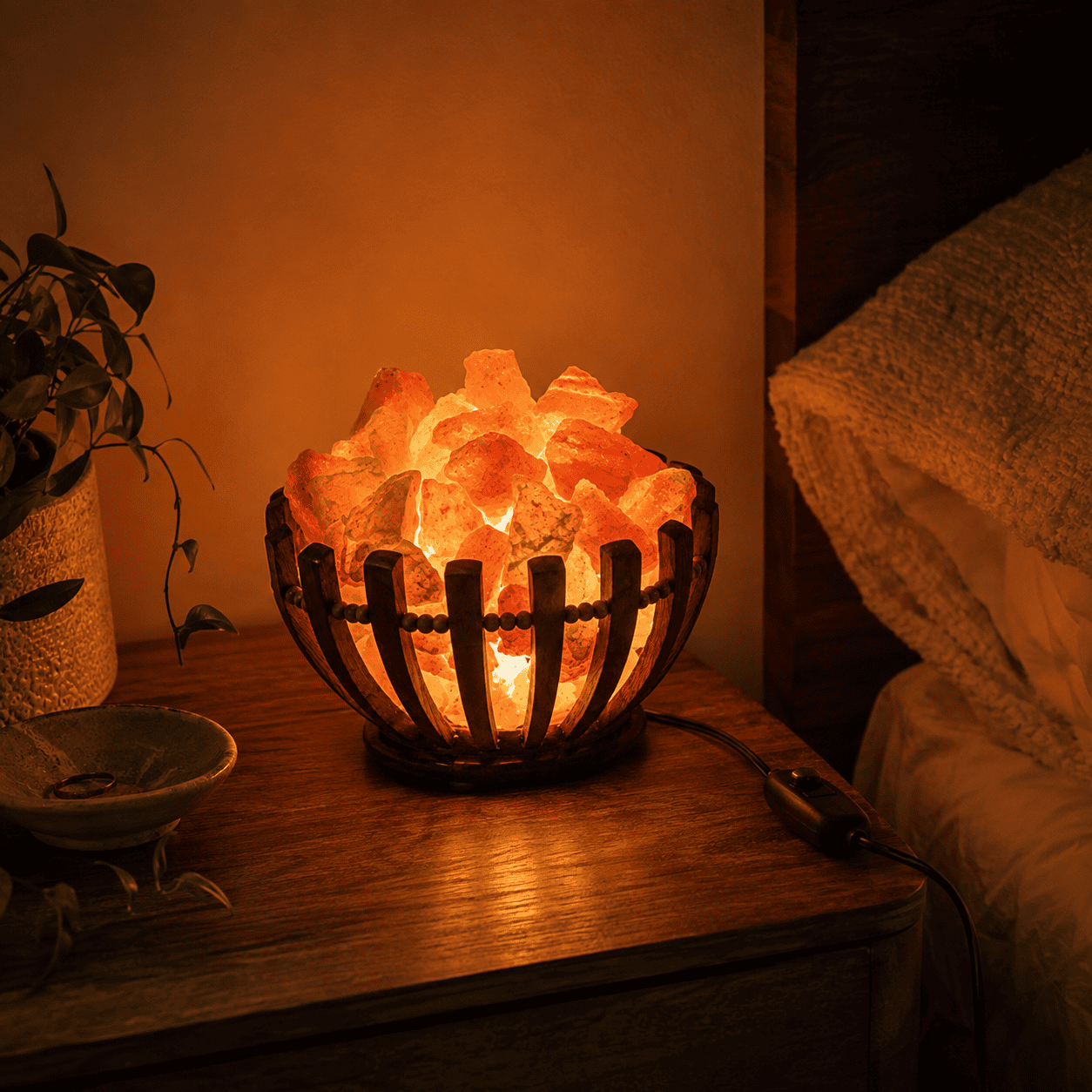
It matters around the home too. Salt lamps and salt blocks are cut from the same unrefined crystal, so there are no synthetic binders or resins in them; they're genuinely natural mineral objects, not a composite pretending to be one.
One honest nuance to close on: additive-free isn't the same as chemically perfect. As a mined product, Himalayan salt can carry tiny traces of naturally occurring elements from the region's geology. Independent testing has generally found these within safe limits, and they come from the earth, not from anything added at the factory.
A quick health note
Additive-free is a real clean-label plus, and it changes none of the fundamentals. It's still salt: mostly sodium chloride, same sodium per gram as any table salt. Total sodium is what your blood pressure notices, so stay inside 6g of salt a day per the NHS, under 5g per the WHO, and keep a reliable iodine source going if Himalayan salt is your main one.
Frequently asked questions
Does Himalayan salt really contain no additives?
Yes. Minimally processed, with no anti-caking agents, bleaching agents or synthetic chemicals, sold as mined from the Khewra Salt Mine in Pakistan.
Why does Himalayan salt clump if it has no additives?
No flow agents. It pulls moisture straight from the air, so a lump in a damp kitchen is the salt behaving normally. An airtight container away from the hob and sink sorts it.
Is Himalayan salt healthier than regular table salt?
Not really. Same sodium per gram, minor trace minerals. The real differences are the missing additives and the missing iodine.
Can I replace iodised salt entirely with Himalayan salt?
You can, as long as dairy, fish or eggs are covering your iodine. Lean on Himalayan salt alone and you risk falling short, since it carries no added iodine.
Explore additive-free Himalayan salt
If a genuinely unrefined salt with a one-word ingredient list is what you're after, the cooking salts are all sourced from the Khewra Mine with no anti-caking agents.