

Himalayan Pink Salt Explained: Origins, Minerals, Benefits & Everyday Uses

We get asked the same thing constantly: is the pink stuff actually better, or is it just a prettier jar? Fair question. Himalayan pink salt has ended up in kitchens, bathrooms and wellness cupboards everywhere, and most of what people believe about it is half right. So here's the honest version of what it is, where it comes from, and how much of the health talk holds up.
You'll come away knowing what you're buying and how to use it, whether you cook with it, bathe in it, or just like the colour on the shelf.
What is Himalayan pink salt?
It's rock salt, the mineral halite, mined from the Khewra Salt Mine in the Punjab region of Pakistan. The name oversells the geography a little. Khewra sits in the Salt Range foothills, roughly 200 km south of the Himalayan mountains proper, so "Himalayan" points at the wider region rather than the peaks. The history of the Khewra Salt Mine covers how the deposit formed and got worked over the centuries.
Chemically it's close to ordinary salt. Analyses put it at around 95 to 98% sodium chloride. That remaining sliver, roughly 2%, is a mix of trace minerals, mostly iron oxide (which is where the pink-to-red blush comes from) plus small amounts of magnesium, potassium, calcium and others. The real difference from table salt isn't nutrition. It's that pink salt is unrefined: hand-extracted, minimally processed, no bleaching, no anti-caking agents, nothing added to keep it flowing.
The history of the Khewra Salt Mine
Khewra is one of the oldest and largest salt mines on Earth. Legend puts its discovery at 326 BC, when horses in Alexander the Great's army were spotted licking the rocks. Organised trading grew under the Mughals. Modern mining, though, really started in 1872, when the British engineer H. Warth cut the main tunnel system that's still in use.
It's the world's second-largest salt mine now, after the Goderich mine in Ontario, Canada, and it's where nearly all pink "Himalayan" salt comes from.
- Salt Range, Punjab, about 200 km from the Himalayas themselves.
- Reserve estimates vary enormously: somewhere from 82 million to 600 million tonnes.
- Around 40 km of tunnels, reaching some 730 m into the mountainside.
- More than 350,000 tonnes a year come out, at roughly 99% pure halite.
- It's a genuine tourist draw too, with underground salt sculptures and a chapel, pulling in up to 250,000 visitors a year.
Mineral composition: what's actually inside
You'll see "84 trace minerals" on plenty of packaging. That number counts elements detectable in tiny quantities, and the whole lot together comes to only about 2% of the salt by weight. Here's what the ones people mention most actually do:
| Mineral | Role in the body |
|---|---|
| Iron | Supports oxygen transport; gives the salt its pink colour |
| Magnesium | Involved in muscle and nerve function |
| Calcium | Supports bones and normal blood clotting |
| Potassium | Helps regulate fluid balance and muscle contraction |
| Zinc | Supports immune function and wound healing |
An independent analysis of pink salts did confirm higher levels of several trace elements than white table salt. The catch: the levels are too low to matter nutritionally unless you ate a genuinely unhealthy amount of salt. Our deep dive on the trace minerals in Himalayan salt goes element by element. The short answer: buy pink salt for flavour, texture and purity, not as a supplement.
Himalayan salt vs. table salt
| Feature | Himalayan pink salt | Table salt |
|---|---|---|
| Source | Khewra rock-salt mine | Evaporated seawater or brine |
| Processing | Unrefined, hand-extracted | Refined, often bleached |
| Additives | None | Often anti-caking agents |
| Minerals | ~2% trace minerals | Almost pure sodium chloride |
| Iodine | Negligible (naturally occurring) | Usually fortified with iodine |
The full comparison of Himalayan salt vs. table salt goes deeper on price and texture. And if the wellness marketing is what's nagging at you, our honest look at whether Himalayan salt is really healthier takes the common claims apart one by one.
Everyday uses of Himalayan pink salt
1. In the kitchen
This is where most people start. Fine grains season and dissolve like any everyday salt; coarse crystals go in a grinder or scatter over a finished plate. Salt blocks and plates handle searing, grilling or serving something chilled. And because it's clean, unrefined salt, it's well suited to brining, pickling and curing. Home cooks who want the detail can read our companion guide to cooking with edible Himalayan pink salt, which covers seasoning and technique properly.
2. Wellness & beauty
- A warm salt bath to soak in at the end of a long day.
- Coarse crystals make a decent exfoliating scrub for dull skin.
- Salt inhalers and steam turn up a lot in home "halotherapy" routines.
3. Home & atmosphere
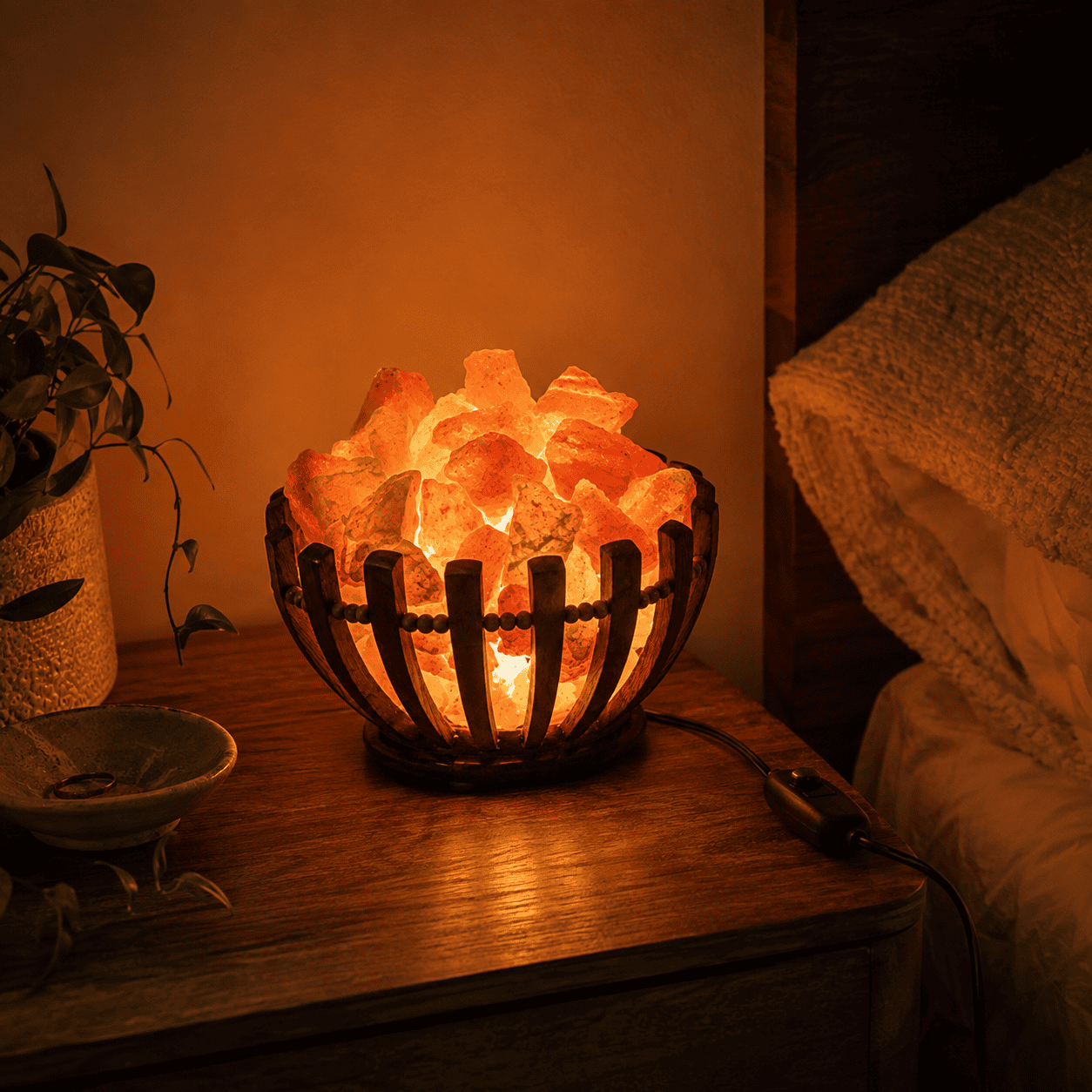
Salt lamps get bought for their warm, low glow more than anything else, and the honest science on their air-purifying claims is worth a read before you expect miracles. Salt tiles and bricks show up decoratively and in sauna walls. If you're after the edible side, browse the edible and wellness Himalayan salt range.
The honest health picture
Here's the caveat that matters, said once: it is still salt. Around 95 to 98% of it is sodium chloride, and the mineral differences versus ordinary salt are real but small. The clean label and lack of additives are the genuine draw.
The UK's NHS advises adults to eat no more than 6 g of salt a day (about a teaspoon, under 2.4 g of sodium), and the World Health Organization suggests less than 5 g. Pink salt doesn't change that maths. Its larger crystals actually mean you're better off measuring by weight than by the spoonful. Anyone managing blood pressure or a heart condition should treat it like any other salt and follow professional advice.
Is Himalayan pink salt safe?
For everyday cooking, yes. It's natural rock salt that people have eaten for centuries. Two things to keep in mind. Being unrefined, it can carry very small amounts of naturally occurring impurities. And it's not a reliable iodine source, so if you've been relying on iodised salt, get iodine from foods like dairy, fish and eggs instead.
How to spot authentic Himalayan salt
- Colour runs from off-white through soft pink to deep red. That variation is normal; a uniform, almost neon pink is the thing to be suspicious of.
- Origin stated as Khewra or Punjab, Pakistan.
- A seller who's open about sourcing and food-grade certification.
If you're comparing products, our Himalayan salt buying guide walks through labels and grades before you commit.
How to store it
Salt pulls moisture straight out of the air, which is why an open jar in a steamy kitchen turns clumpy. Keep it airtight, away from steam and humidity, and it'll last more or less forever. A few grains of rice in the grinder help soak up damp and stop it seizing.
Frequently asked questions
Is Himalayan pink salt better than sea salt?
Nutritionally they're close. Both are minimally processed with trace minerals, but pink salt has a broader mineral profile and, being ancient rock, dodges the microplastic contamination now showing up in some sea salts.
Does it contain iodine?
Barely any. Use iodised salt or foods like fish, dairy and eggs.
Can it fully replace table salt?
Yes, for most cooking. Just remember the crystals are bigger, so a spoonful weighs less than the same spoon of fine table salt. Season to taste, and weigh it where precision counts.
Final thoughts
Pink salt isn't magic, and it isn't a scam either. It's a clean, additive-free, characterful rock salt from an ancient mine, and it earns its place in the kitchen on flavour and honesty rather than health claims. Buy it for what it is.
Have a look through our salt tiles and bricks if you want the cooking-slab side of things.